
Baroque Meets Tropical Modern: Library
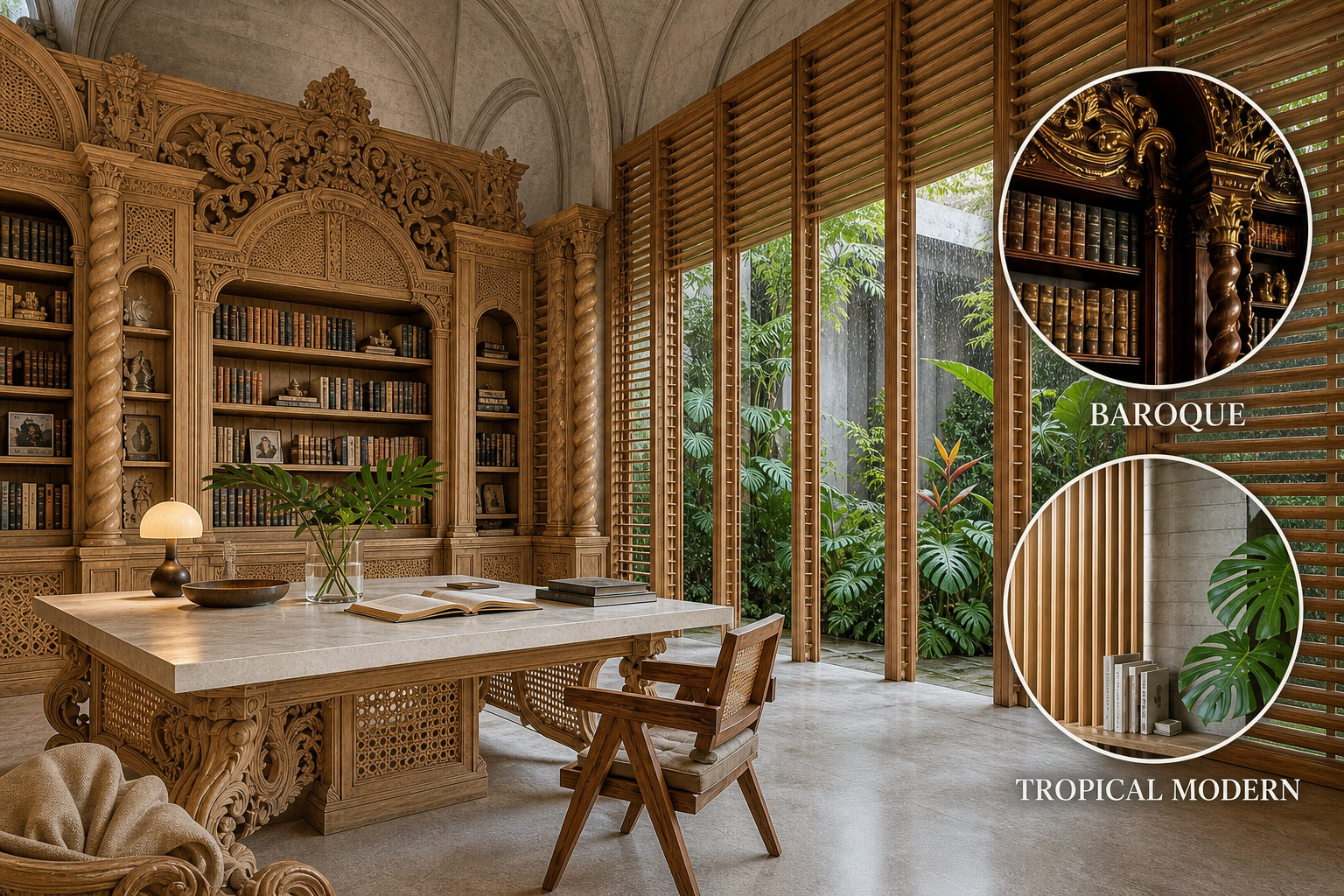
The heavy, enclosed excess of seventeenth-century Europe clashes entirely with the light, climate-adapted minimalism of Southeast Asian modernism. We resolve this profound contradiction by building grand Baroque architectural volumes exclusively out of raw, highly breathable Tropical Modern materials.
Establishing the Baroque Geometry
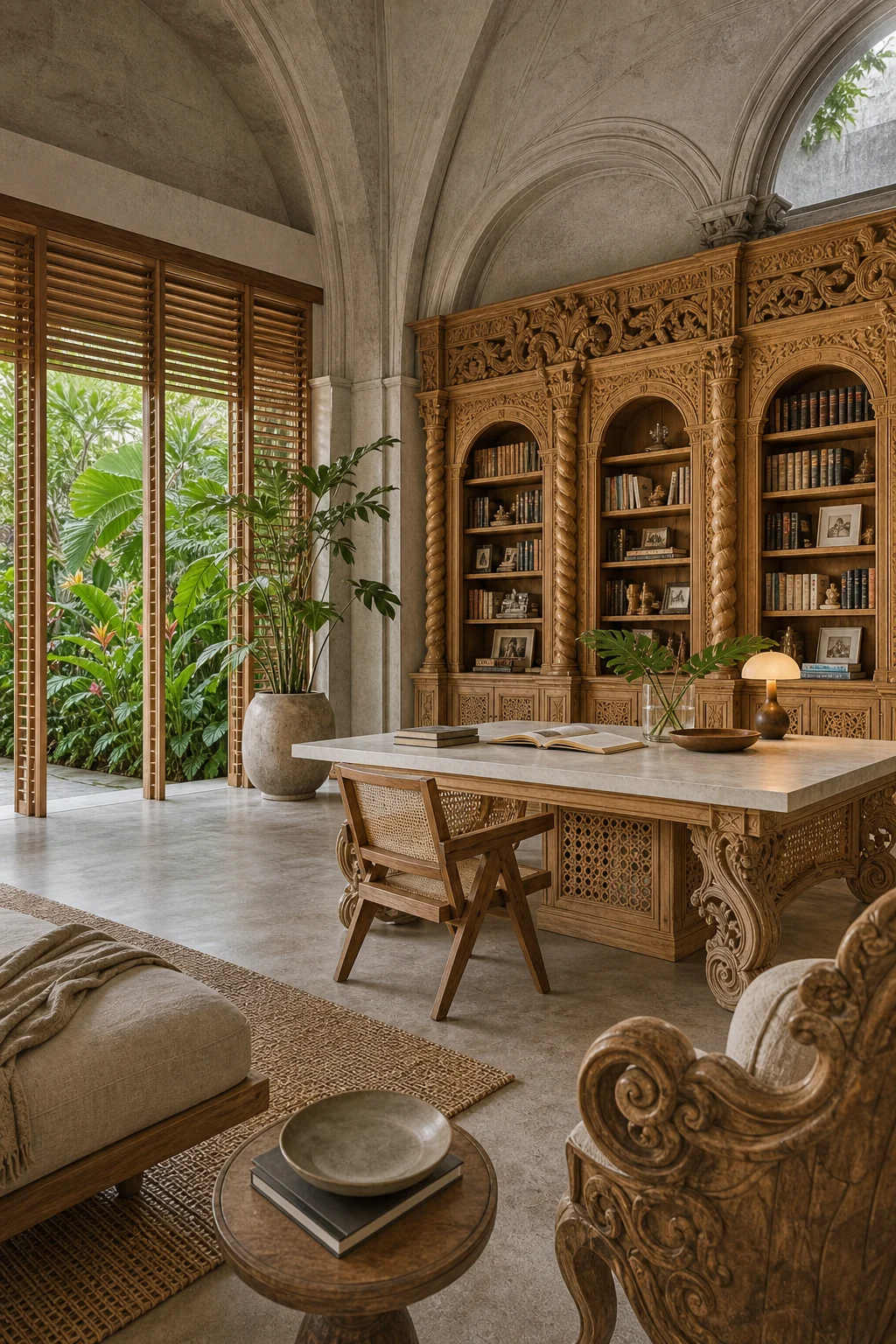
Baroque design relies heavily on dramatic, sweeping curves and monumental scale. To anchor the room, we establish a grand historic framework using sweeping, multi-tiered arched bookcases and intricate Solomonic twisted columns that permanently define the entire spatial volume of the humid library.
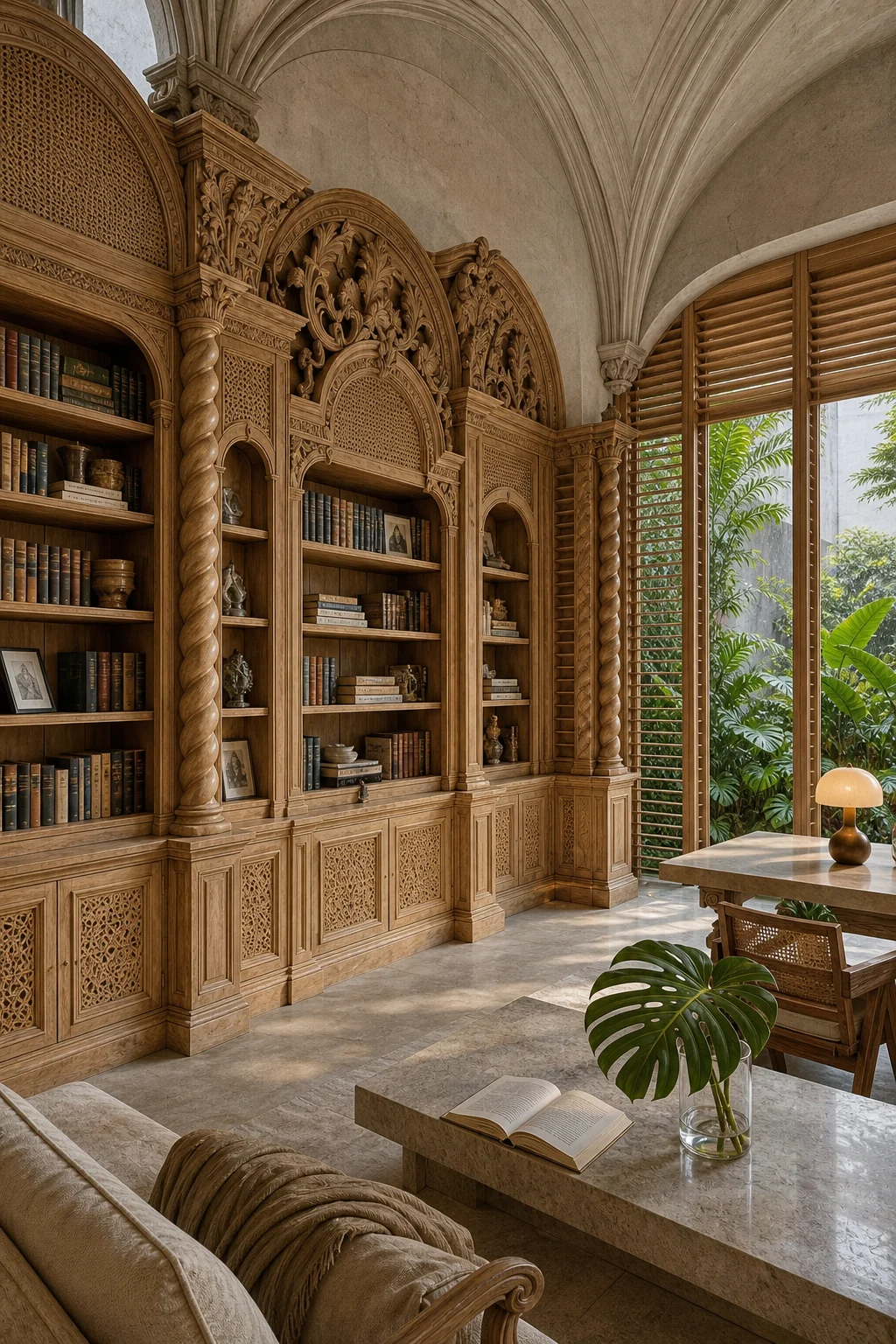
These monumental historic shapes dictate the room’s primary visual rhythm. By carving them entirely from raw, unvarnished pale teak instead of traditional dark mahogany, we instantly strip away the oppressive physical and visual weight normally associated with heavily enclosed seventeenth-century European antiquity.
We deliberately swap solid masonry backings for highly breathable woven rattan panels. This critical material substitution introduces essential natural airflow while perfectly maintaining the sweeping arches that give the tropical library its unmistakable seventeenth-century architectural authority and profound historic gravity.
Opening the Tropical Modern Envelope
To successfully prevent the ornate shelving from feeling visually oppressive, the surrounding architecture must actively breathe. We replace solid masonry walls with operable floor-to-ceiling teak louvers that seamlessly adapt these grand, enclosed historic forms to the harsh realities of the hot, humid tropics.
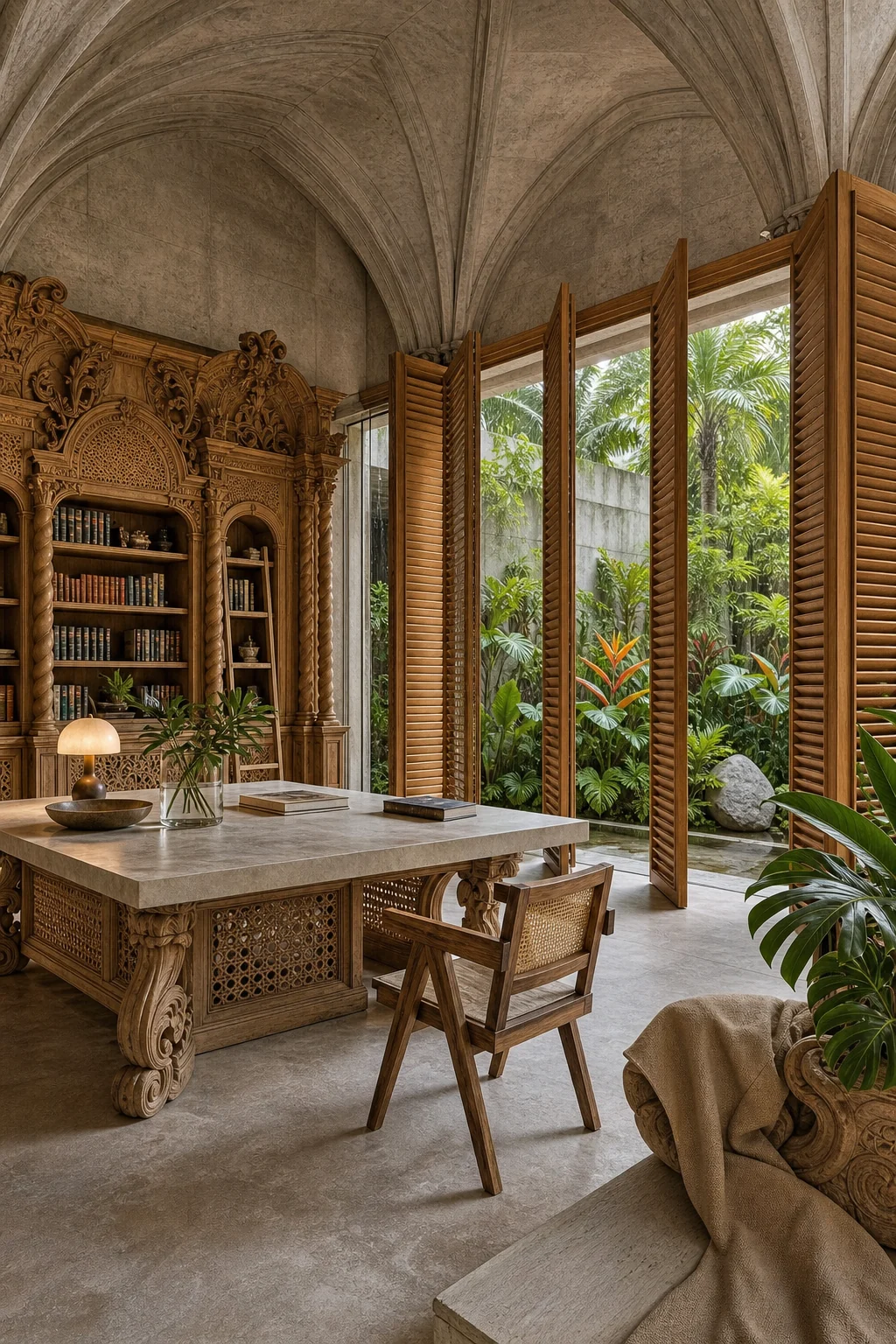
These massive operable teak panels completely erase the traditional boundary between the formal interior library and the lush exterior courtyard. The humid climate becomes a central design feature, actively inviting cooling cross-breezes that physically lighten the exceptionally heavy historic architectural volumes.
- Remove solid exterior masonry walls entirely to eliminate trapped tropical heat and unwanted moisture.
- Install massive floor-to-ceiling teak louvers to control natural tropical airflow and filter harsh sunlight.
- Cast the sweeping vaulted dome ceilings in raw, breathable board-formed concrete instead of plaster.
- Erase the visual boundary between the formal interior library and the wet tropical courtyard.
Bridging Through Raw Materials
The ultimate success of this hybrid space relies entirely on a unified pale material palette. By strictly restricting the room’s colors to warm teak and pale stone, intricate architectural shadows completely replace the need for applied pigments or heavy traditional gilding.
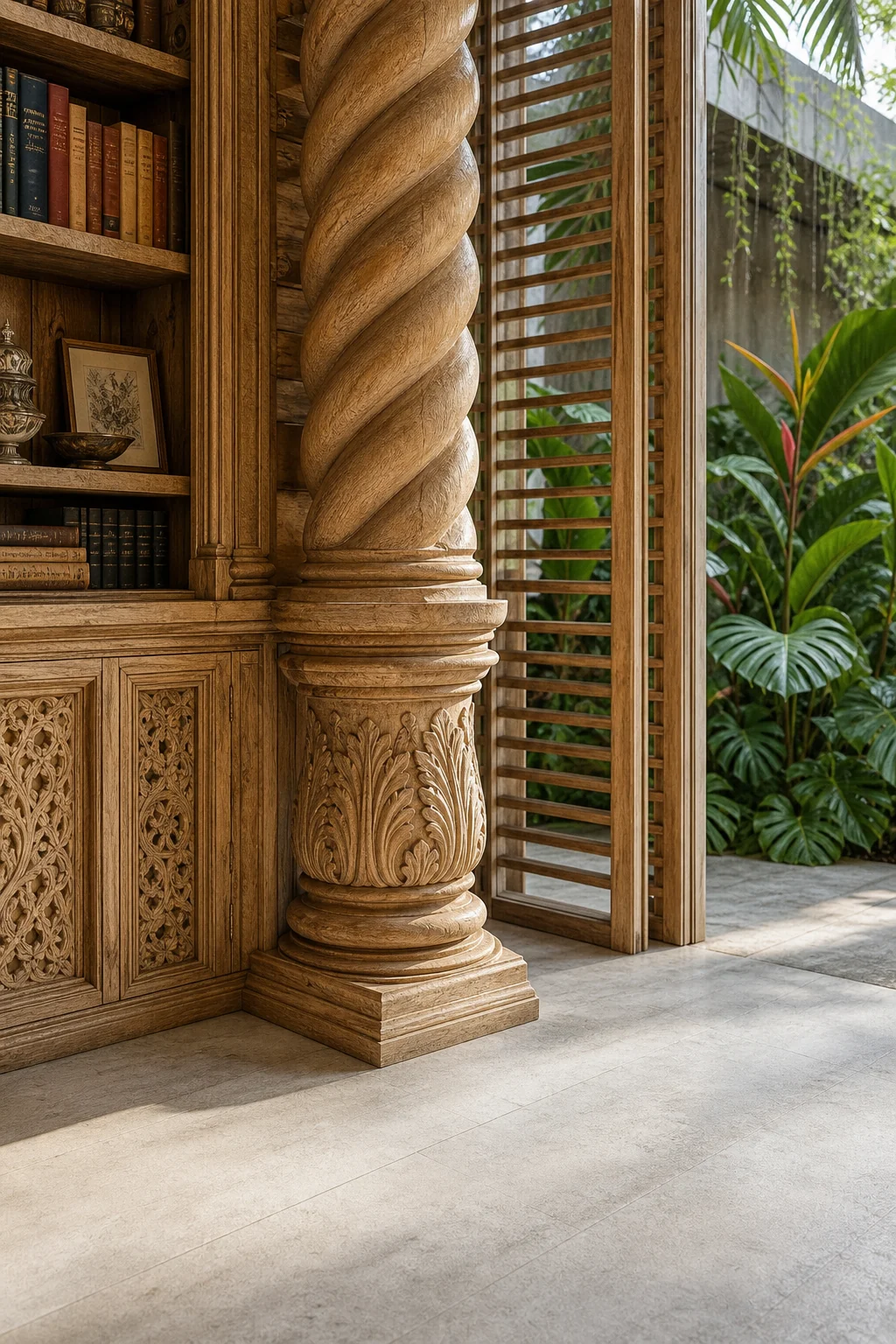
Translating ornate Baroque carvings directly into raw, unvarnished teak instantly removes the immense visual weight of the historic era. The natural grain of the tropical wood beautifully softens the intense formality of the carving, making the grand shapes feel organic rather than ostentatious.
When the base of an ornate twisted column meets a smooth concrete floor, the resulting contrast must remain purely textural. The pale concrete actively reflects ambient daylight upward, beautifully highlighting the deep, tactile relief of the completely unvarnished, intricately carved tropical wood.
Building the Room
A central reading table effectively grounds the library by physically merging both distinct design aesthetics. We combine an ornate, heavily carved wooden base with a sleek, minimalist stone surface to create a perfectly balanced functional focal point for the entire room.
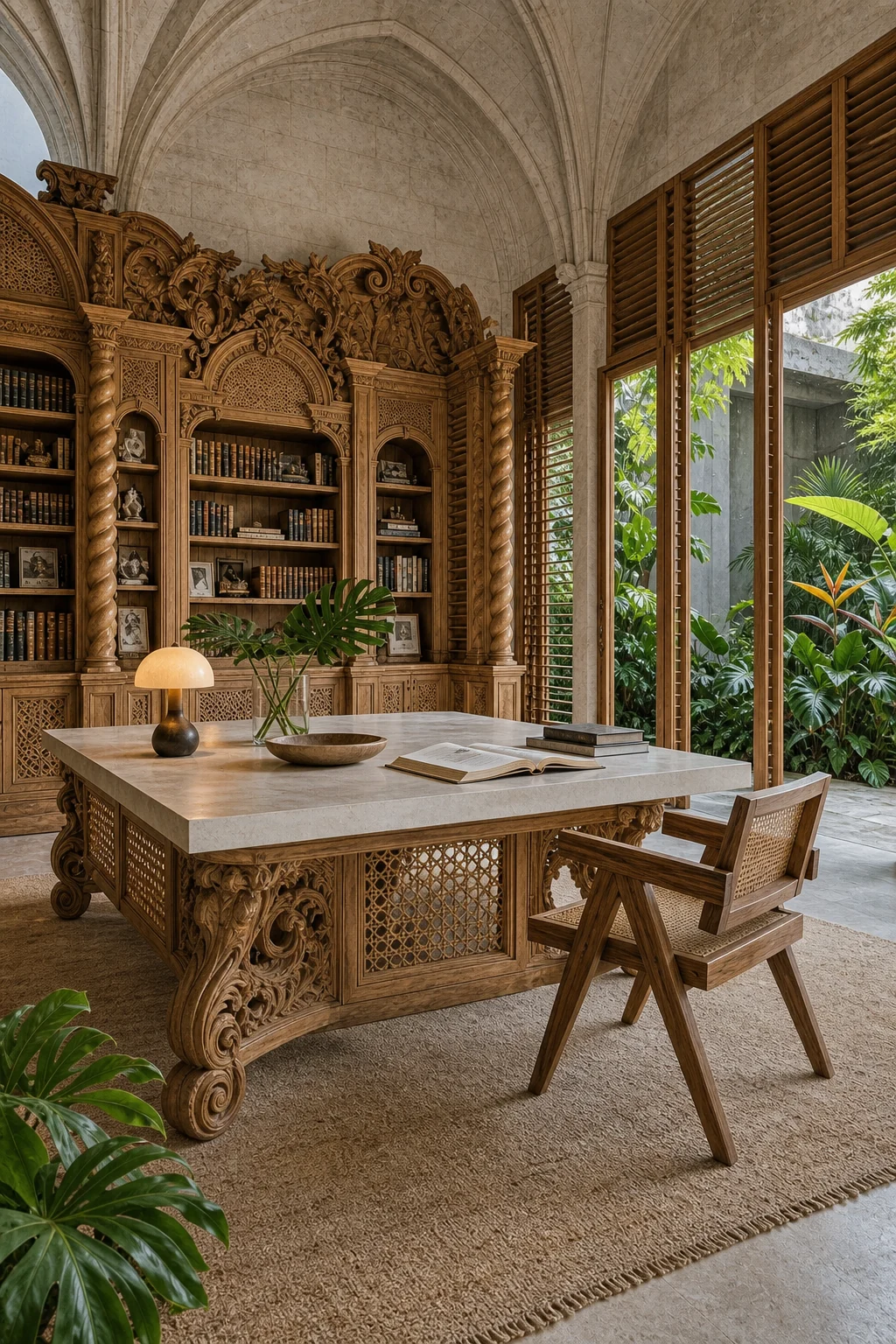
This deliberate hybrid furniture approach successfully prevents the room from feeling like a dusty historic museum. The raw teak base provides essential historic gravity, while the honed limestone top offers the clean, unadorned utility absolutely essential to authentic Tropical Modernism.
| Baroque Role | Tropical Modern Role | The Bridge |
|---|---|---|
| Grand vaulted ceilings | Raw board-formed concrete | Pale, unpainted concrete vaults |
| Heavy carved table bases | Sleek minimalist surfaces | Carved teak under honed limestone |
| Heavy velvet drapery | Breathable woven cane | Rattan panels inset in grand frames |
| Ornate chandeliers | Concealed architectural lighting | Simple glowing ambient table lamps |
| Gilded antiques | Structural tropical foliage | Curated art books alongside wet greenery |
By mapping each design layer systematically, we ensure neither aesthetic ever visually overwhelms the other. The heavy velvet drapery of the seventeenth century yields to breathable woven cane, perfectly maintaining grand historic proportions without the suffocating thermal retention of traditional European fabrics.
Sculpting with Overcast Light
Silvery monsoon daylight pours directly through the open courtyard, beautifully lifting all interior midtones. This soft, perfectly balanced editorial exposure keeps the deep shadows of the ornate carvings open and highly detailed without ever requiring harsh, visually distracting artificial spotlights.
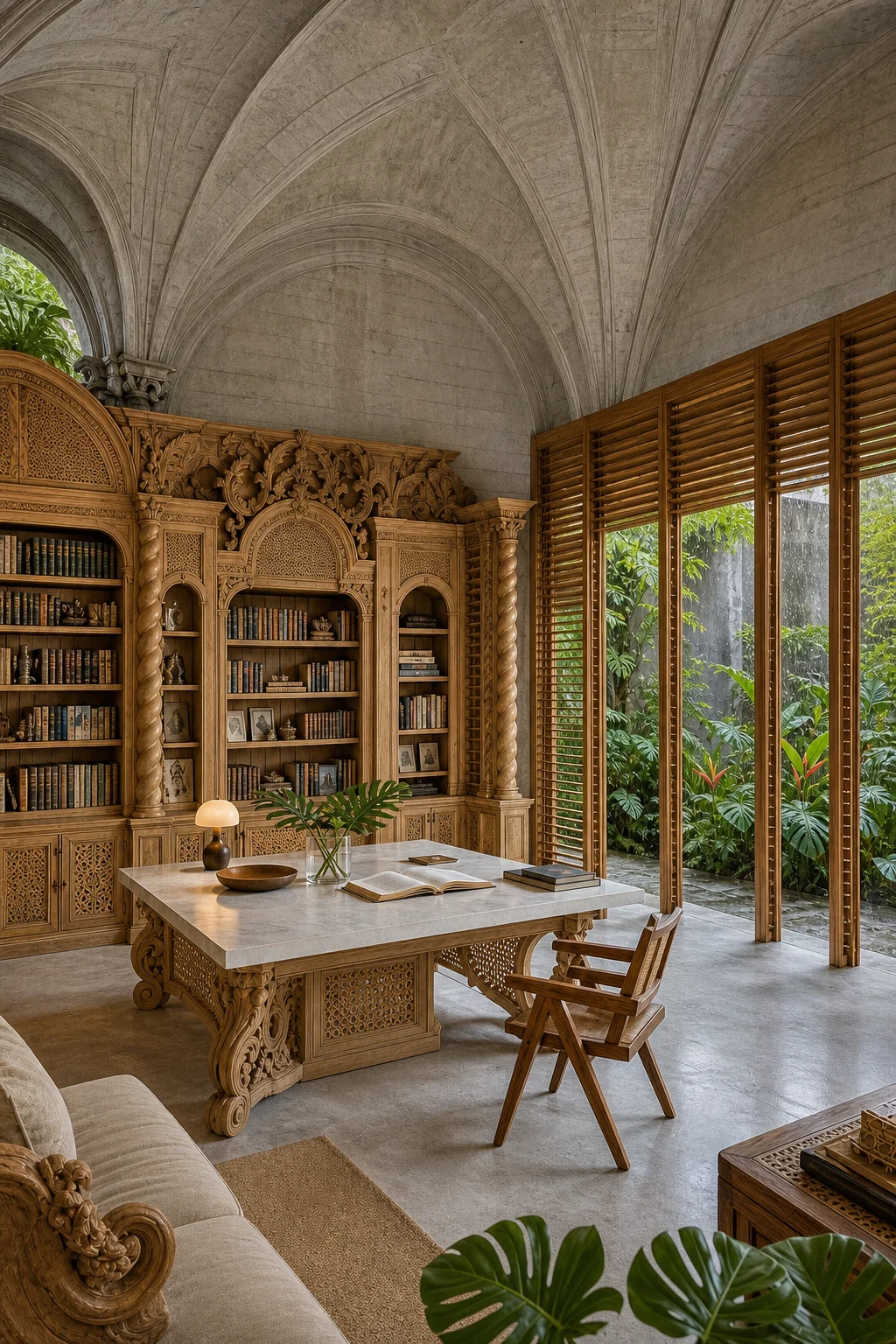
We actively maximize indirect natural light to gently soften the exceptionally heavy, imposing architectural forms. The pale, matte surfaces of the raw concrete and honed limestone continuously bounce this diffused illumination upward into the deepest corners of the grand vaulted ceiling.
- Maximize indirect natural daylight to gently soften the heavy, imposing historic architectural forms throughout the library.
- Use pale matte surfaces to continuously bounce soft ambient illumination into the deepest corners of the vaulted ceiling.
- Avoid harsh directional spotlights that create aggressive, highly distracting shadows across the intricate unvarnished woodwork.
Styling the Details
When the architectural shelving itself is highly decorative, the objects it holds must remain strictly restrained. A few carefully curated pieces successfully prevent the intricate, sweeping woodwork from feeling visually overwhelming or needlessly cluttered within the serene, minimalist tropical environment.
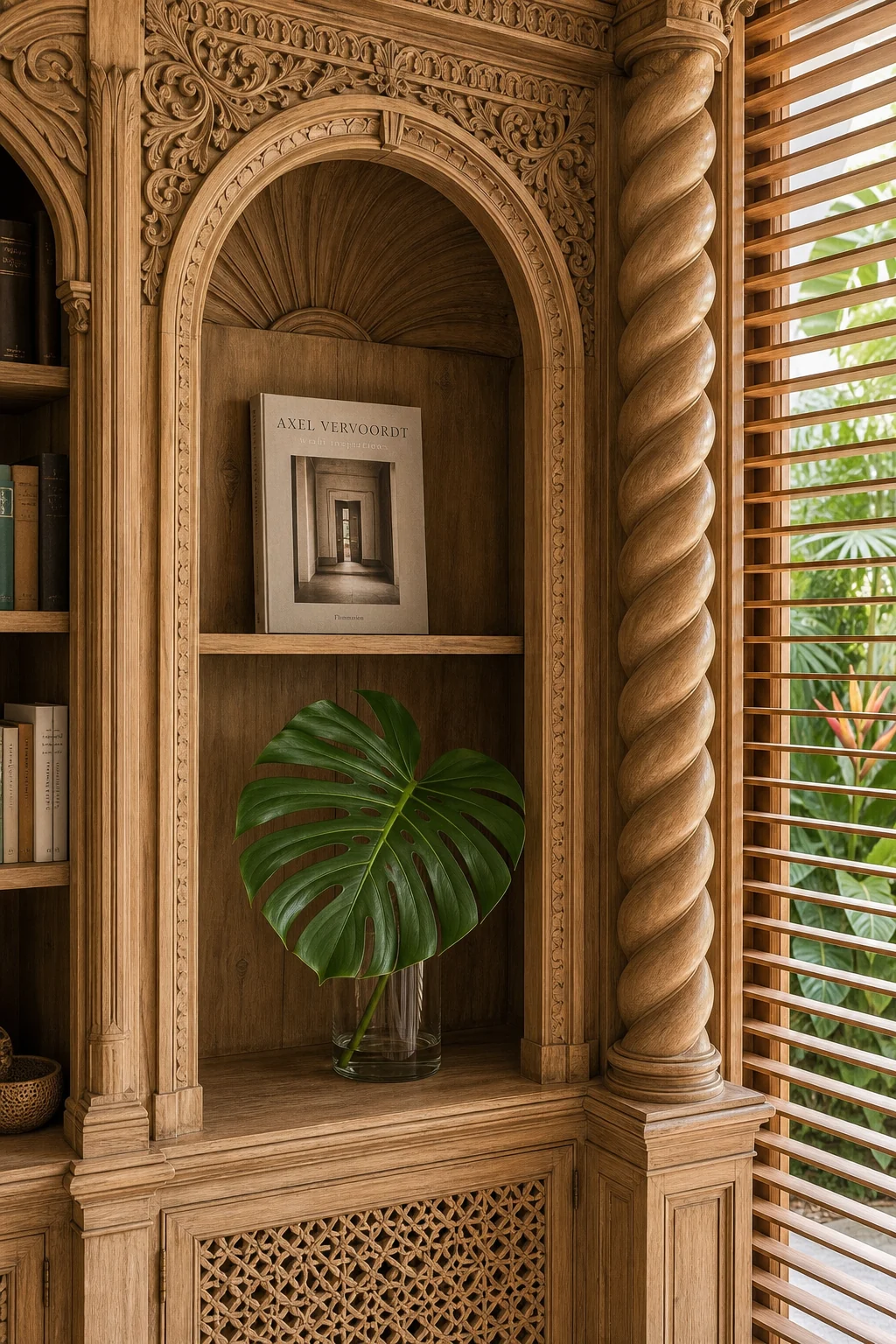
We deliberately replace dusty antique collections with vibrant, structural green Monstera leaves and simple terracotta vessels. This minimalist styling approach allows the grand Baroque bookcases to stand entirely alone as the primary artistic statement without competing for unnecessary visual attention.
- Source raw unvarnished teak lounge chairs featuring highly breathable woven cane seats to maintain essential natural airflow.
- Select pale honed limestone side tables designed with incredibly simple, unadorned geometric profiles to balance the ornate carvings.
- Incorporate matte ceramic table lamps emitting warm, diffused ambient light across the raw board-formed concrete surfaces.
- Display large structural tropical plants housed in simple, perfectly unglazed terracotta vessels to introduce vibrant organic color.
Adapting the Threshold
You can easily apply this precise design logic to much smaller transitional spaces. A simple residential hallway can effectively utilize woven rattan panels and a pale concrete ceiling without ever requiring the massive architectural volumes of a grand historic library.
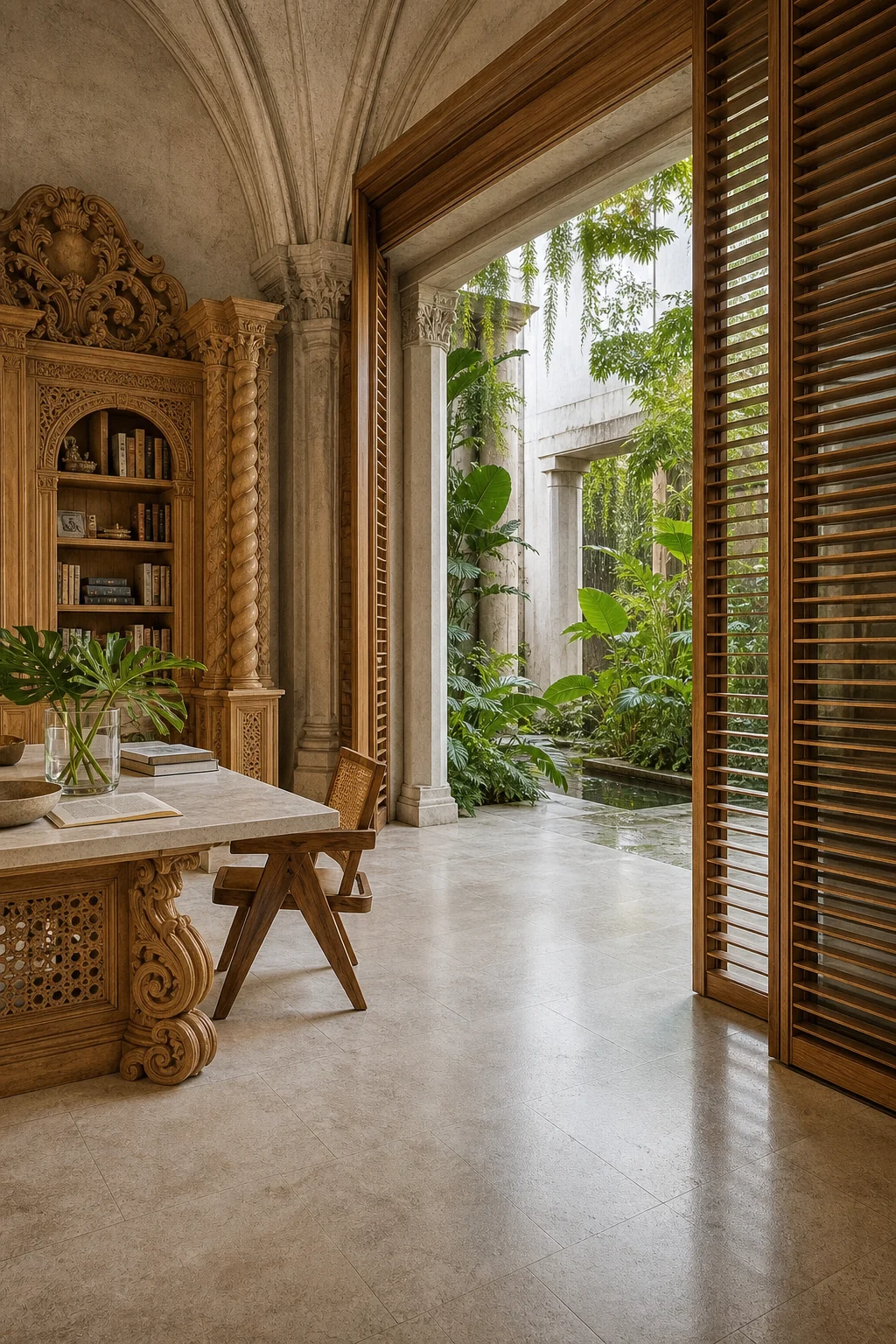
The interior spatial progression flows seamlessly outward into the wet tropical greenery. By maintaining the exact same material constraints in these smaller transitional areas, you ensure the entire home feels like a cohesive, climate-adapted sanctuary rather than a disjointed historic gallery.
This strict material continuity naturally draws the eye outward toward the lush courtyard. The simplified architectural threshold perfectly prepares the viewer for the intense organic beauty of the vibrant, unstructured tropical environment waiting just beyond the massive operable teak louvers.
Avoiding the Costume
This delicate visual balance fails entirely if either aesthetic dominates the fundamental material choices. The room must remain a unified, climate-adapted architectural shell, not a heavy historic European replica accidentally dropped into the middle of a dense, humid jungle.
To succeed, you must commit strictly to the established material constraints. Avoid these common failure modes to ensure the finished library remains a deliberately resolved contradiction rather than a chaotic, unlivable architectural collision of two entirely competing historic design eras.
- Never apply traditional gold leaf or metallic paint to the raw tropical hardwoods under any design circumstances.
- Never design one complete wall to be entirely historic while leaving another wall entirely sleek and modern.
- Do not erase the grand historic architectural curves in favor of standard, generic modern geometric boxes.
- Avoid sealing the room with solid masonry when breathable, operable teak louvers are absolutely required for ventilation.