
Regency Meets Indochine: Library
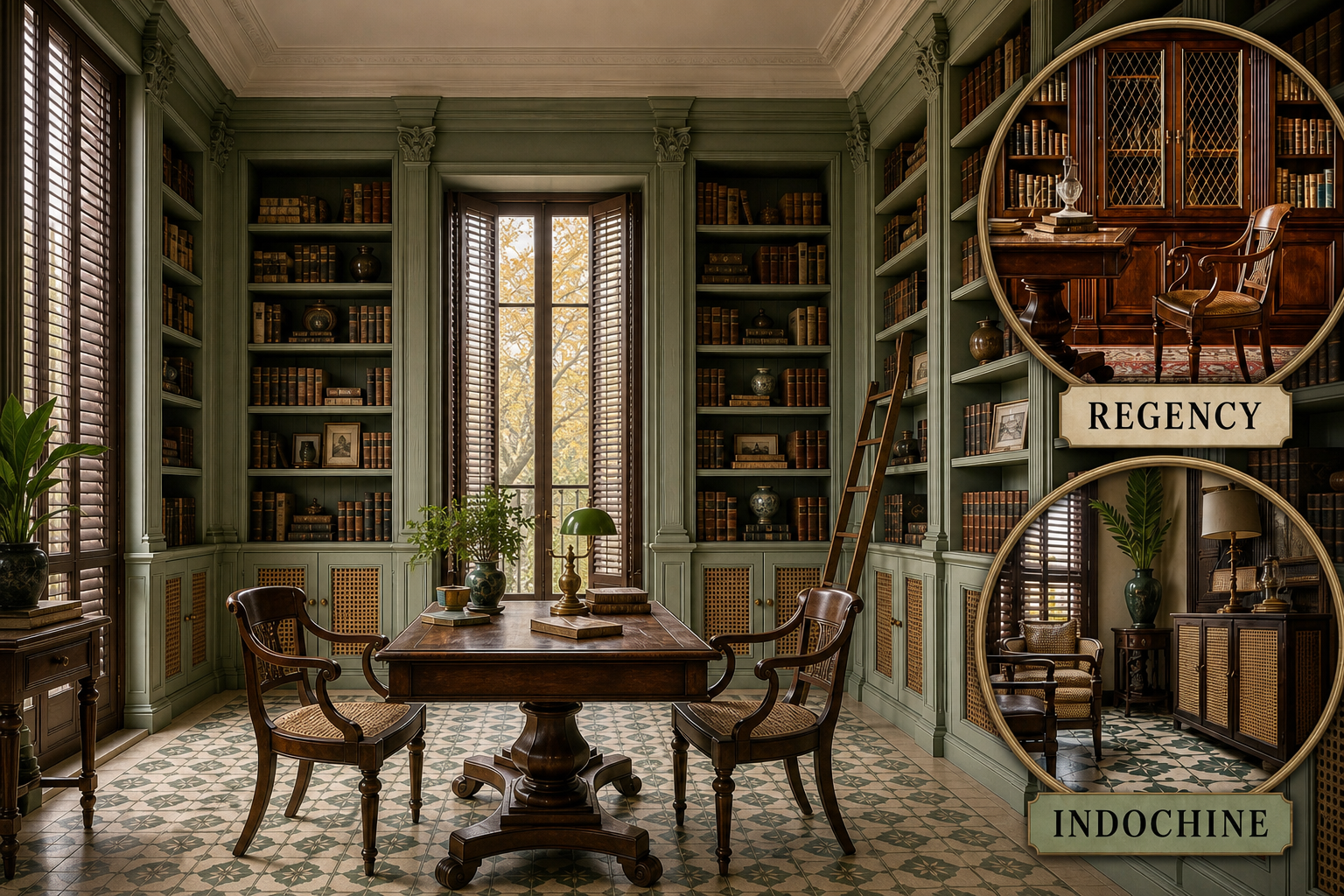
The rigid, enclosed formality of British classical revival often clashes with the humid, ventilated ease of Southeast Asian tropical living. We resolve this tension by letting Regency dictate the formal architectural symmetry while Indochine provides the dark teak and rattan.
Formal Classical Architecture
Regency design demands strict symmetry and classical proportions to establish a sense of unwavering order. We honor this architectural envelope with floor-to-ceiling built-in bookcases and traditional crown moldings, setting a highly formal stage that grounds the entire room in tradition.
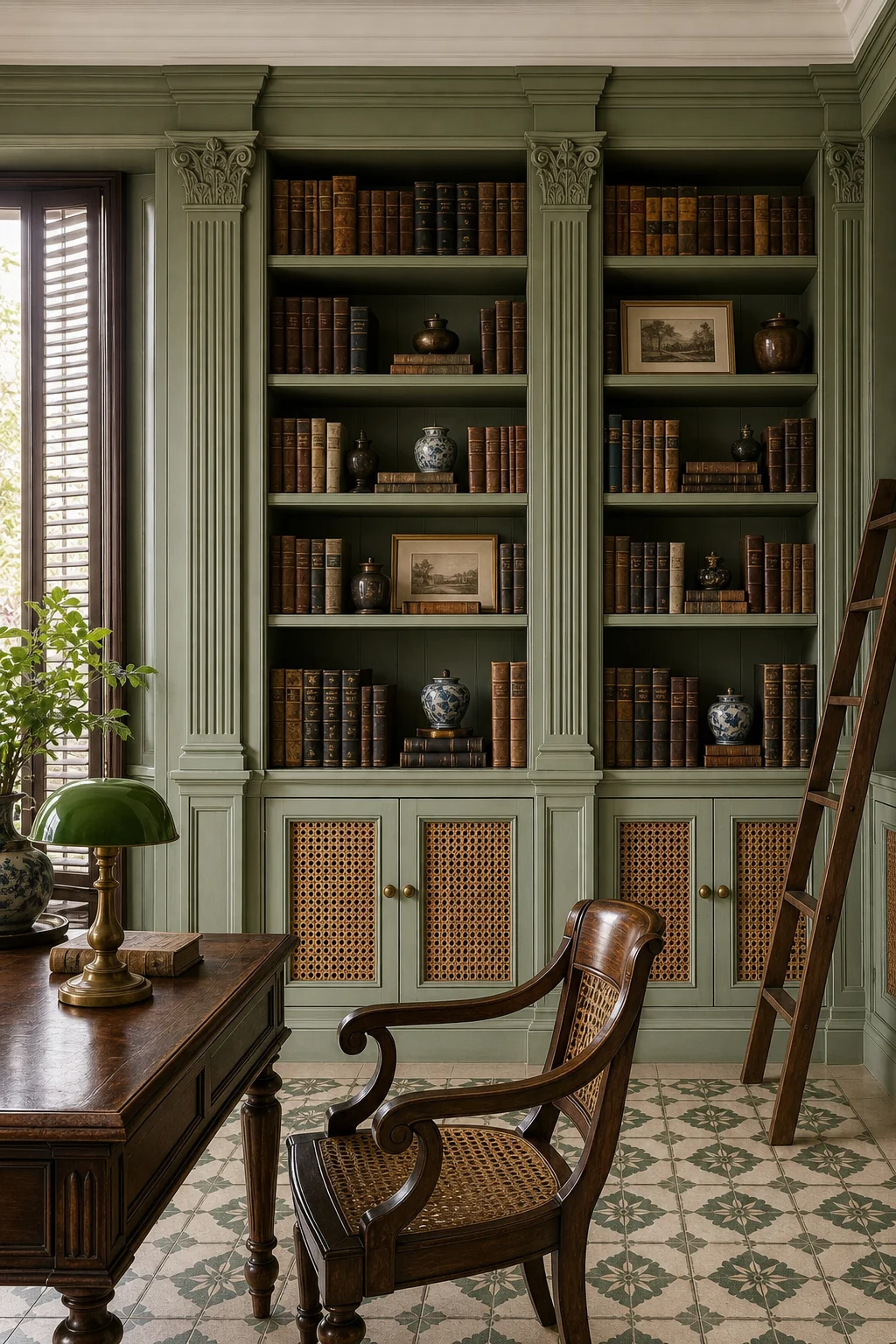
The faded celadon green woodwork establishes a strong, traditional British foundation for the library. Yet, by deliberately omitting heavy mahogany doors, the framework immediately begins to negotiate with its environment, preparing the eye for lighter, more breathable tactile textures.
This disciplined approach to the room’s perimeter ensures the hybrid aesthetic never loses its academic roots. The classical moldings provide a necessary visual boundary that anchors the lighter, indigenous materials we will introduce across the lower half of the space.
Tropical Climate Adaptation
Indochine style prioritizes constant airflow and cooling materials to combat intense tropical heat. We swap heavy velvet drapery for louvered wooden shutters and replace stifling wool rugs with breathable encaustic cement floor tiles, ensuring the enclosed space breathes effortlessly.
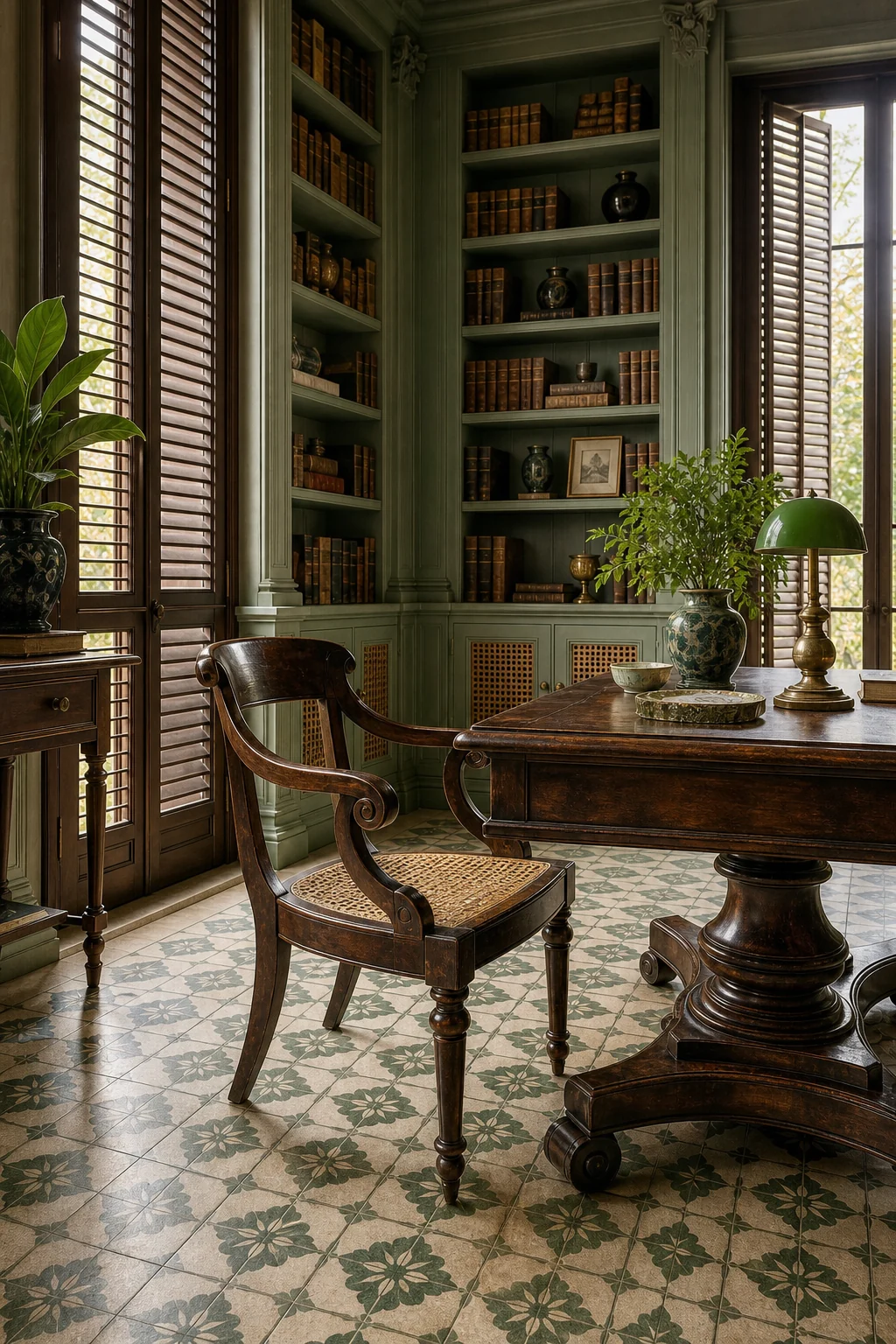
These patterned floor tiles introduce a distinct Southeast Asian rhythm directly beneath the formal furniture. This cooling foundation actively challenges the stuffy academic library stereotype, offering a highly practical solution for warm-weather climates without sacrificing an ounce of historic elegance.
- Select encaustic cement floor tiles to naturally cool the room and introduce subtle, rhythmic geometric patterns underfoot.
- Install louvered wooden window shutters to actively filter intense sunlight while maximizing essential natural cross-ventilation inside.
- Replace heavy upholstered panels with breathable woven rattan to prevent moisture buildup in highly humid tropical environments.
- Prioritize bare, polished surfaces over heavy textiles to maintain a crisp, comfortable ambient room temperature all year.
Material Substitution
The true conceptual connection happens when formal British silhouettes meet indigenous Southeast Asian materials. Instead of utilizing imported mahogany and solid upholstery, classical library furniture is meticulously carved from dark tropical teak and expertly fitted with tightly woven cane.
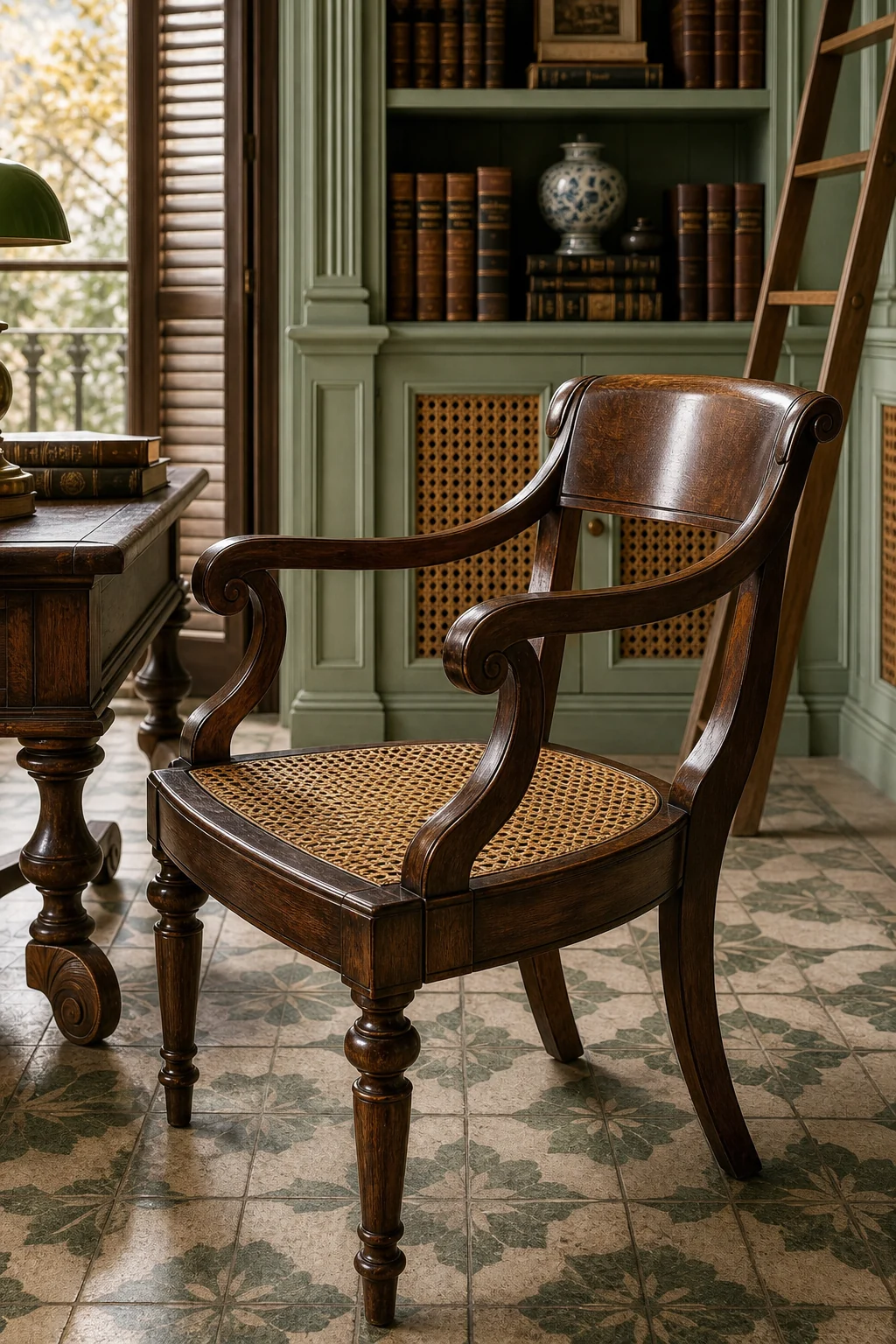
Notice how the formal saber-leg chairs retain their strict historical shape but completely change their character. The dark tropical timber grounds the delicate classical curves, while the caned seat offers climate-appropriate comfort that heavy leather simply cannot provide.
- Execute classical British silhouettes entirely in indigenous tropical timber to maintain the structural dignity of the room.
- Replace solid upholstered backs with tightly woven cane to provide essential climate-appropriate comfort for long reading sessions.
- Assign form strictly to Regency and material strictly to Indochine to permanently resolve the underlying architectural contradiction.
The Central Vignette
Centering the library requires a commanding focal point that perfectly balances both conflicting aesthetics. A traditional pedestal desk grounds the space, surrounded by breathable seating that prevents the formal furniture arrangement from feeling visually heavy or physically oppressive.
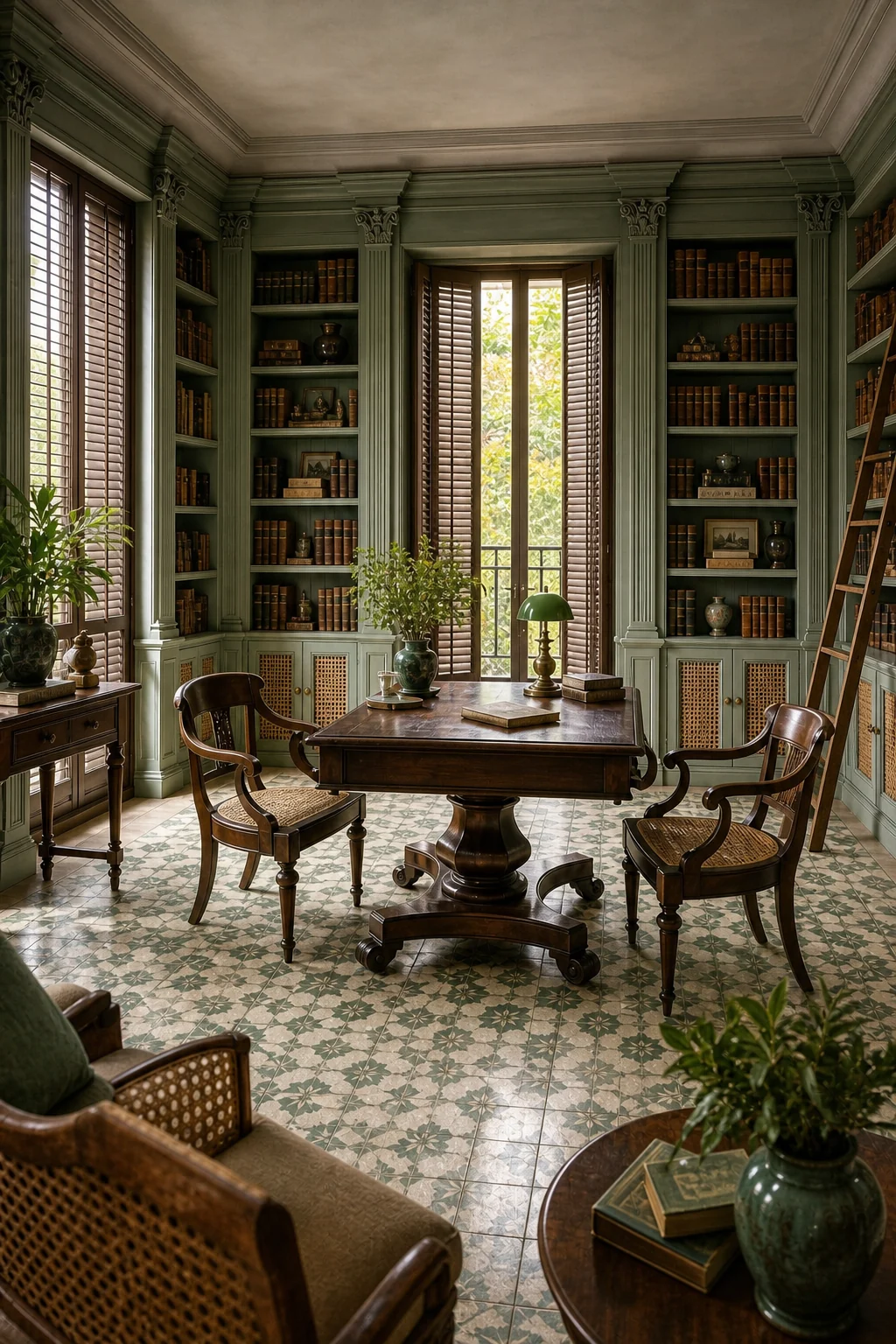
The desk anchors the room’s symmetry, acting as the gravitational center for our hybrid approach. Surrounding it with woven textures ensures the heavy teak does not overwhelm the delicate encaustic floor tiles, maintaining a delicate equilibrium between weight and air.
| Design Layer | Regency Role | Indochine Role | Bridge Decision |
|---|---|---|---|
| Shell | Symmetrical built-in bookcases and classical crown moldings | Encaustic cement floor tiles and louvered window shutters | Faded celadon green paint unifying the architectural woodwork |
| Furniture | Formal pedestal desks and traditional saber-leg chairs | Local dark tropical teak wood and indigenous craftsmanship | Classical British silhouettes executed entirely in indigenous tropical timber |
| Accents | Brass library hardware and traditional wire cabinet grilles | Woven rattan, natural cane, and local ceramic vessels | Rattan panels replacing brass wire on the lower cabinet doors |
| Lighting | Structured, symmetrical task lamps and formal picture lights | Aged brass finishes and deep green glass materials | A classic banker’s lamp updated with tropical patinas |
This translation table reveals the strict discipline behind the room’s aesthetic success. By preventing the two styles from competing within the same design layer, the library achieves a seamless integration that feels both historically informed and geographically appropriate.
Diffused Illumination
Lighting must respect the formal architectural mood while simultaneously highlighting the tactile tropical surfaces. The misty autumn light of Hanoi filters through the shutters, softening the rigid classical symmetry and warming the rich grain of the ebonized teak furniture.
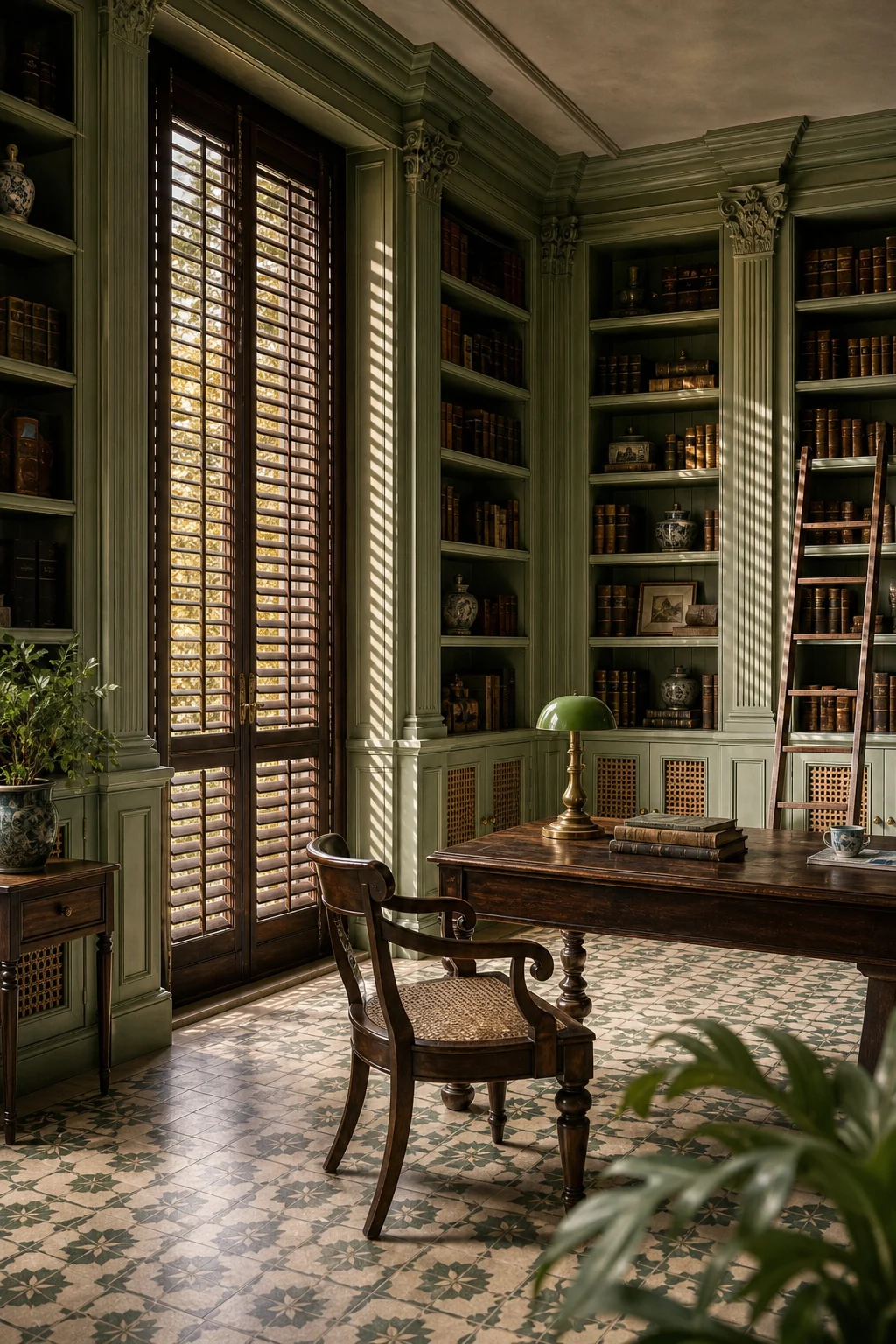
The resulting shadows cast a dynamic, linear pattern across the static celadon bookcases. This interplay between moving light and fixed architecture brings a quiet, lived-in energy to the formal library space, highlighting the woven textures of the lower cabinets.
As evening approaches, symmetrical task lighting takes over, reinforcing the Regency order. Aged brass fixtures cast warm pools of light across the desk, enhancing the rich grain of the dark tropical rosewood while maintaining the room’s studious, academic atmosphere.
Curated Surfaces
Accessories bridge the final gap between British academia and Southeast Asian craft. Gold-tooled leather spines sit alongside aged brass objects and local ceramics, ensuring the shelves feel genuinely collected over time rather than artificially staged for a photograph.
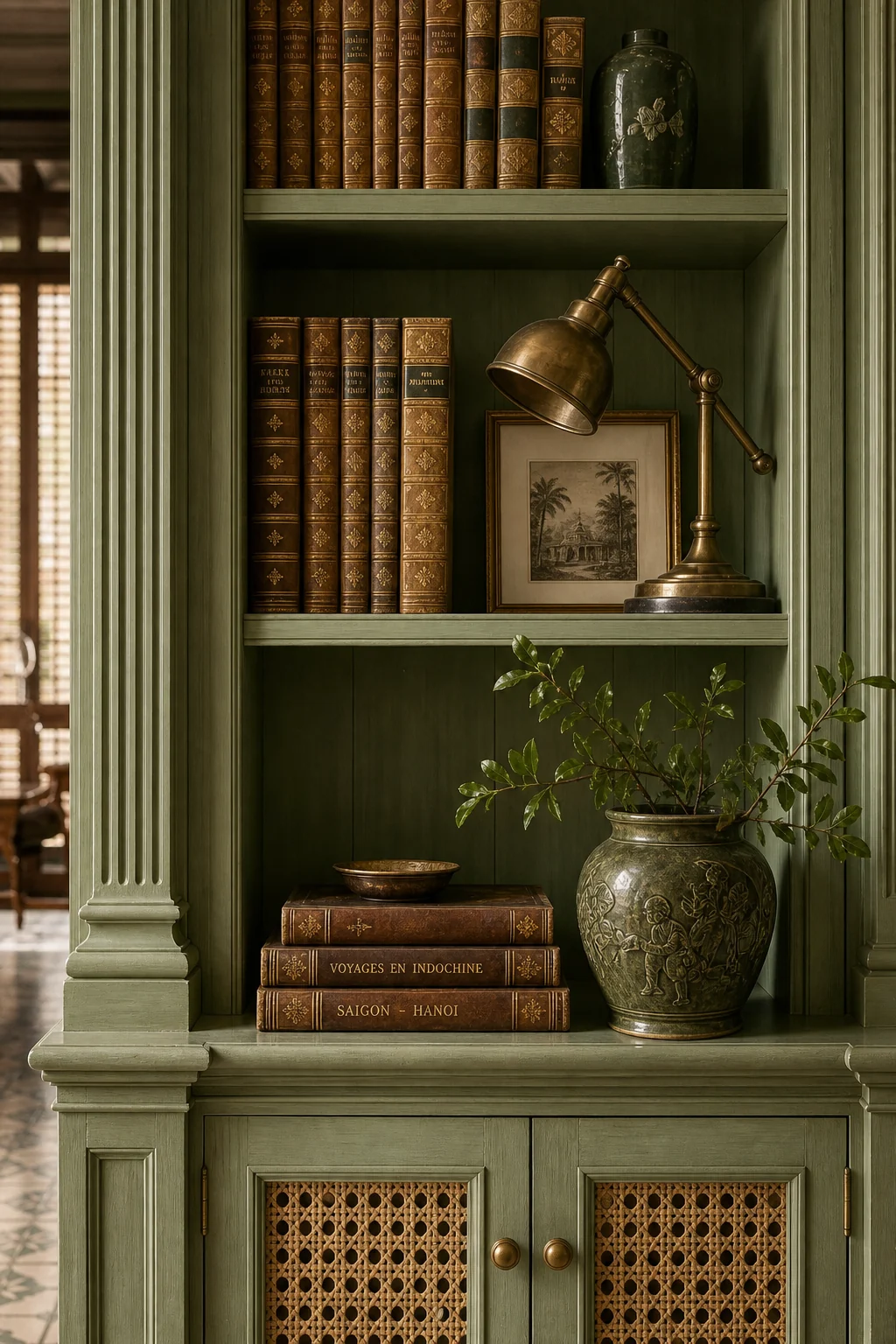
This close-up reveals the subtle dialogue between imported tradition and local artistry. The faded green ceramic vase perfectly echoes the celadon woodwork, while the metallic accents catch the ambient room light, adding a necessary layer of refined polish.
- Source symmetrical task lighting in aged brass finishes to firmly anchor the pedestal desk and open shelving.
- Invest in woven cane seating that maintains a formal posture while offering essential tropical ventilation and comfort.
- Select patterned encaustic tiles in muted ivory and green to beautifully ground the room’s entire color palette.
- Install custom louvered window treatments to manage harsh light and provide authentic, highly functional architectural window detail.
Beyond the Library
This hybrid logic easily translates to transitional spaces and projects with smaller budgets. You can introduce the entire aesthetic in a simple hallway by pairing a classical console table with a woven rattan mirror and a few patterned tiles.
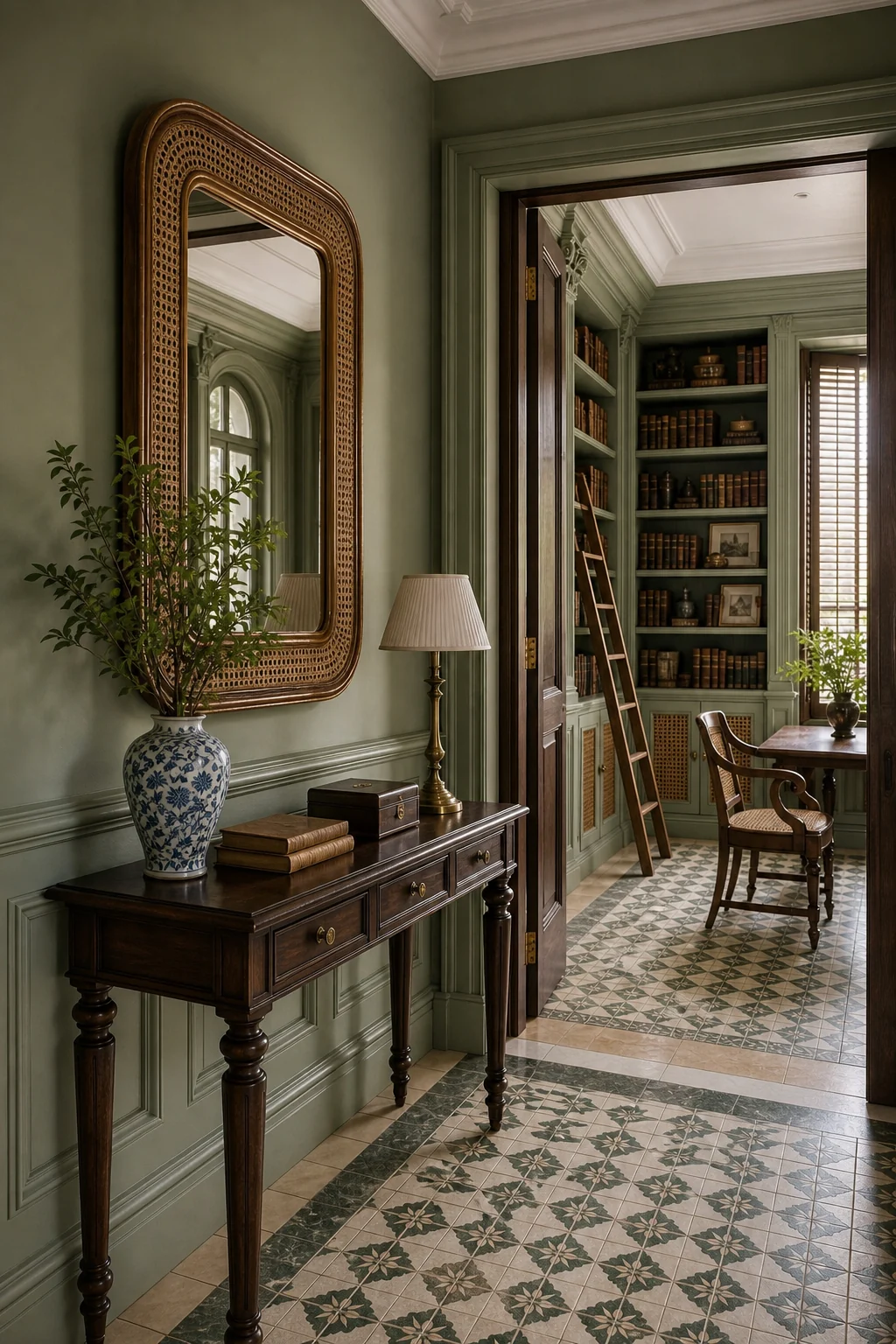
The hallway proves that the concept scales down beautifully without losing its impact. Even without floor-to-ceiling cabinetry, the tension between a formal dark teak console and a relaxed woven mirror communicates the entire design narrative in a single glance.
Maintaining the celadon and ivory color palette ensures seamless continuity between these different rooms. By keeping the background deliberately quiet, the contrasting textures of polished wood and raw cane remain the primary visual focus of the transitional space.
Achieving Balance
A successful hybrid avoids feeling like a colonial movie set or a disjointed split personality. By strictly assigning form to one style and material to the other, the room achieves a lasting harmony that feels both intentional and effortless.
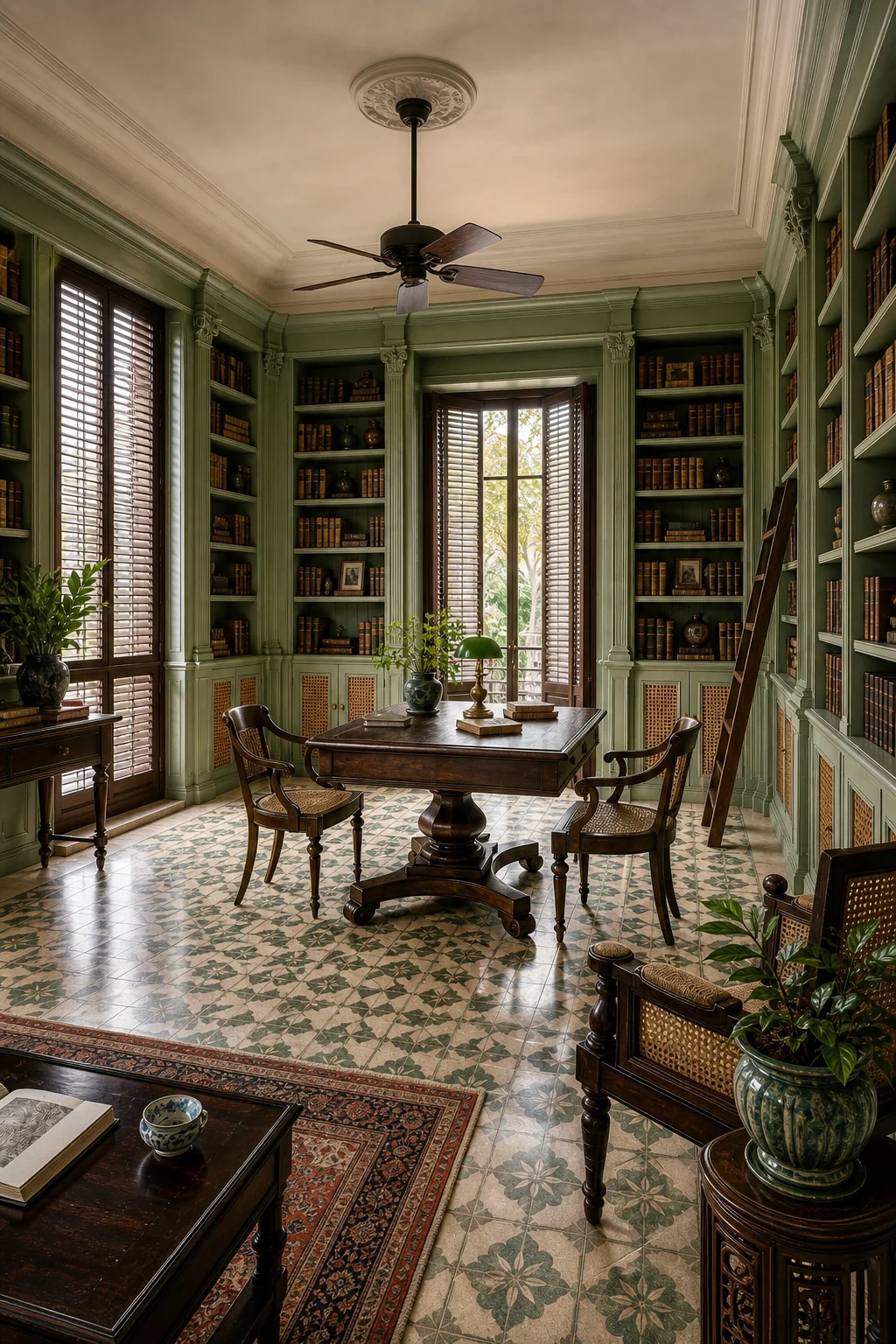
This generous wide view confirms the ultimate success of our strict translation rules. The Regency architecture provides the necessary intellectual discipline, while the Indochine materials invite you to actually sit, read, and comfortably linger in the tropical heat.
- Check the symmetry of your largest architectural elements to ensure the formal Regency foundation remains visually dominant.
- Verify that heavy textiles have been entirely replaced by breathable rattan, natural cane, or slatted louvered wood.
- Confirm that all formal furniture silhouettes are executed exclusively in dark, indigenous tropical timber rather than mahogany.