
French Traditional Meets Minka: Dining Room
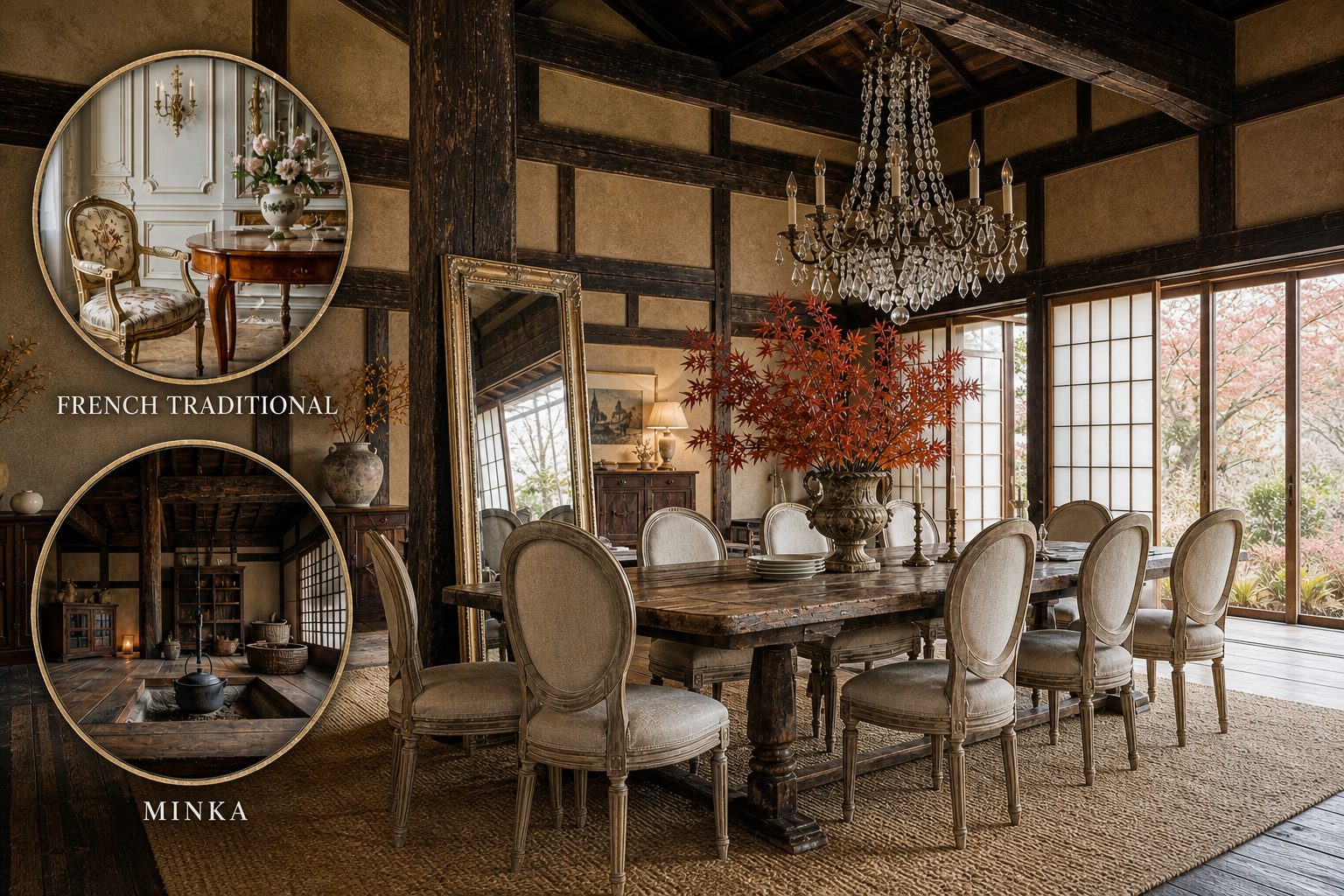
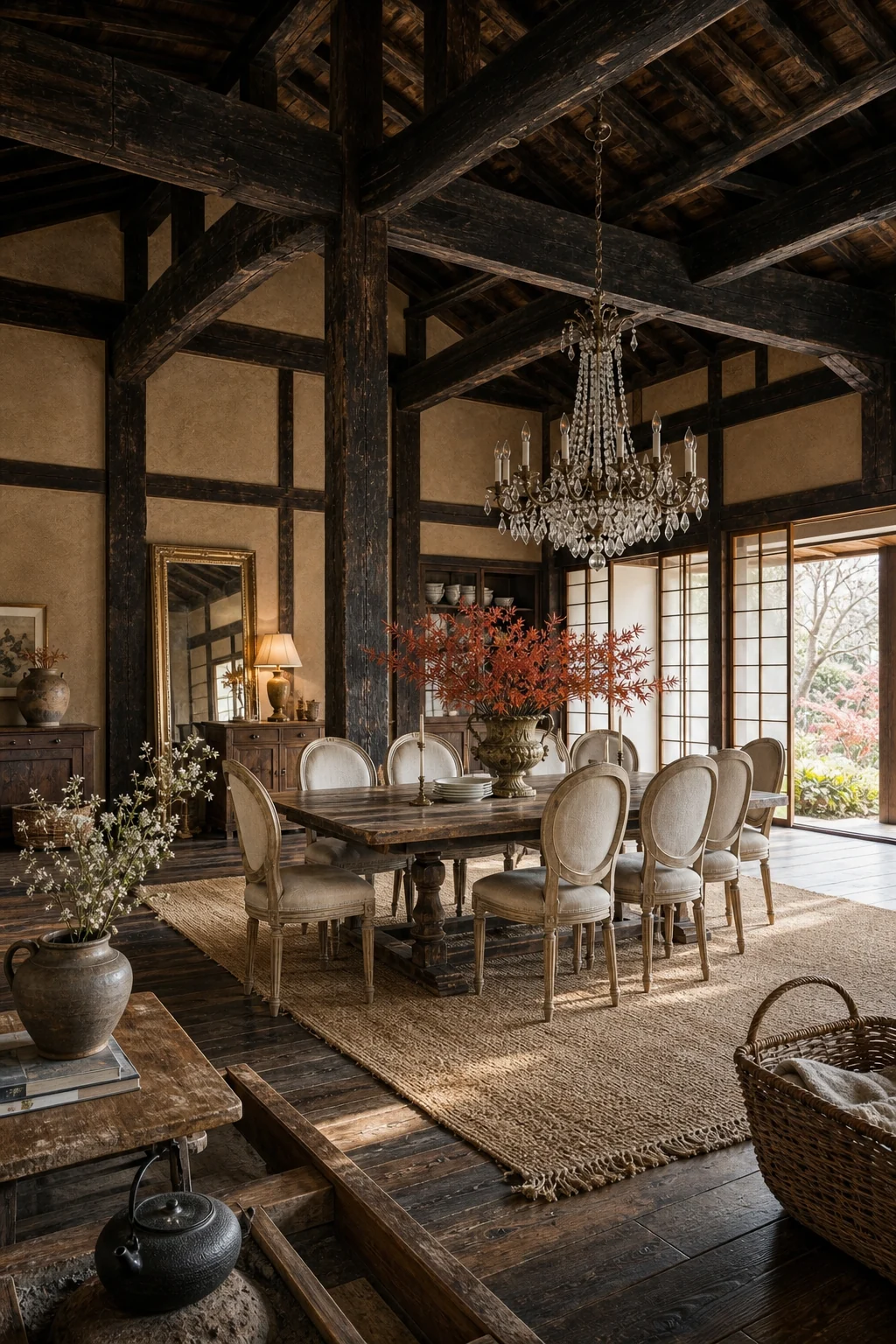
The delicate, symmetrical refinement of aristocratic French furniture inherently clashes with the heavy, asymmetrical mass of a Japanese agrarian timber house. We elegantly resolve this contradiction by letting the Minka architecture provide a grounded, historic structural shell for formal seating.
French Traditional Elegance
Formal European antiques require generous breathing room to avoid feeling like a stifling museum exhibit. By placing delicate fluted legs and carved profiles against rough earthen walls, the ornate craftsmanship suddenly feels highly intentional, beautifully grounded, and refreshingly approachable for daily living.
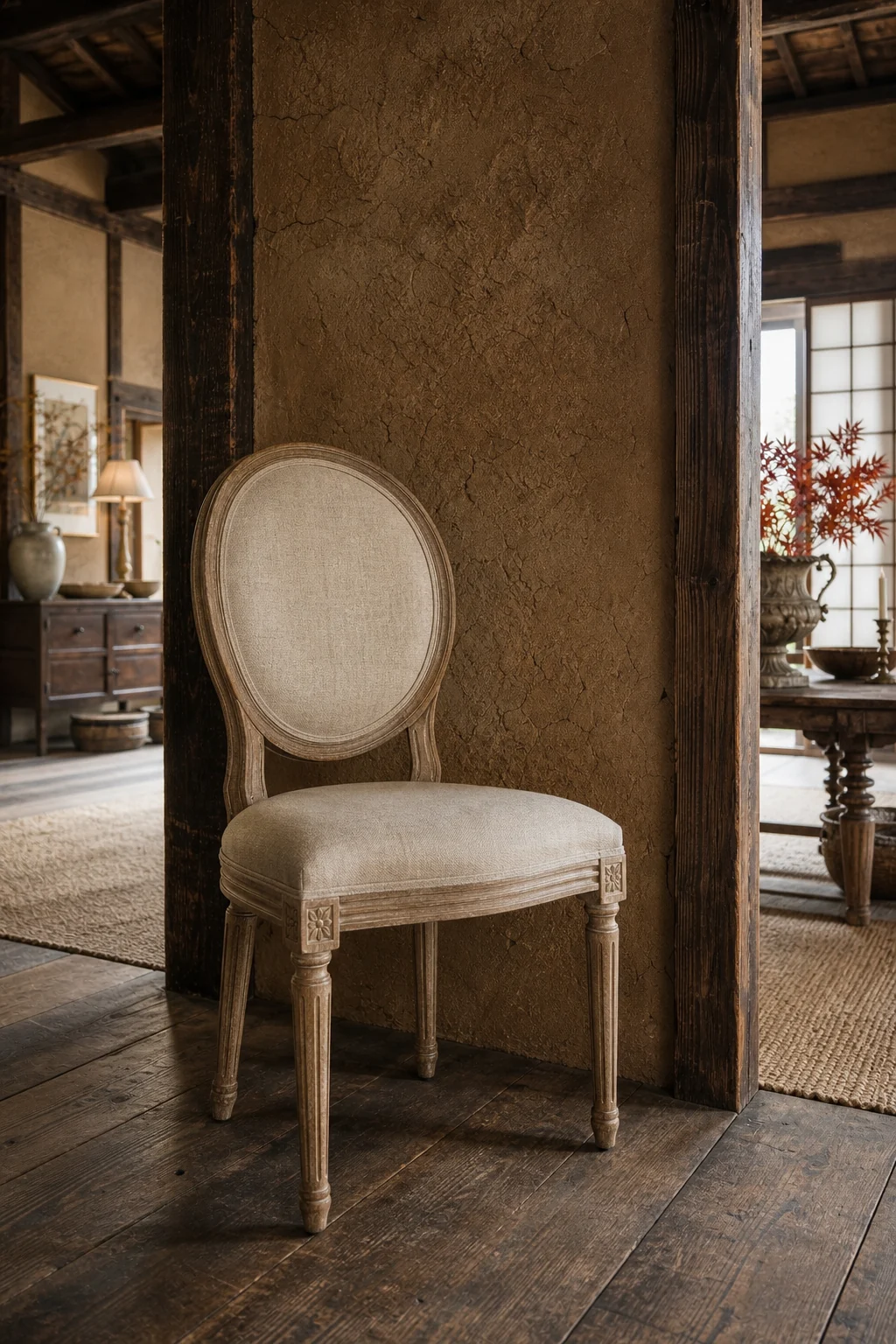
Notice how the intricate woodwork of the seating stands out brilliantly against the raw architectural backdrop. This deliberate material contrast highlights the inherent elegance of the aristocratic furniture without overpowering the room’s deeply rooted, historic rustic charm and tactile warmth.
- Select classic medallion chairs featuring breathable, unbleached linen upholstery to soften the formal seating.
- Keep all wood finishes slightly distressed rather than applying a highly polished, reflective modern gloss.
- Lean tall, tarnished gilt mirrors casually against the walls instead of formally mounting them.
Minka Architectural Weight
The agrarian Japanese structure provides a massive, soot-darkened timber skeleton that defines the entire spatial volume. This heavy central pillar anchors the room perfectly, preventing delicate European chairs from floating aimlessly in the expansive, open floor plan of the historic dwelling.
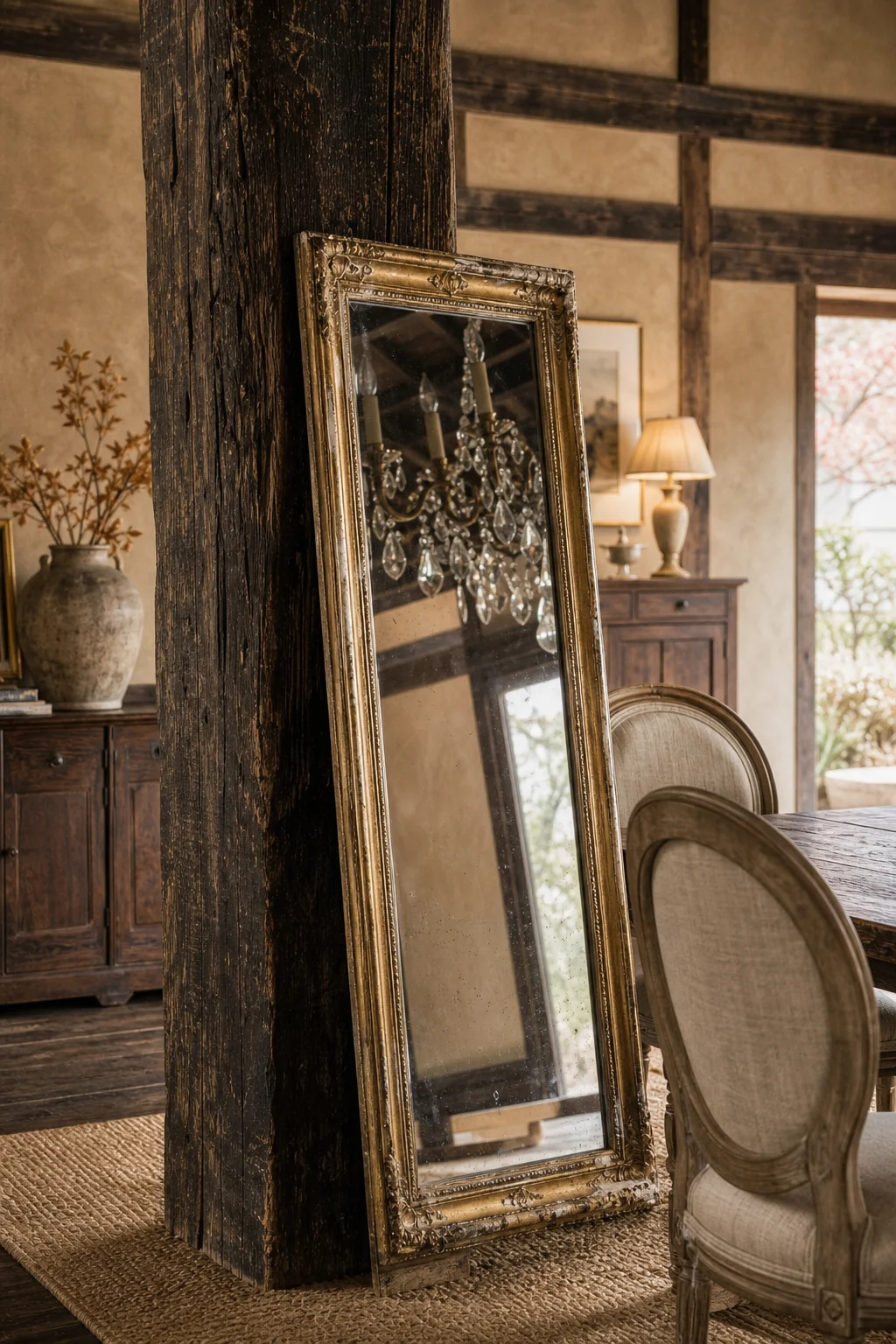
The thick, historic wooden pillar frames the leaned mirror perfectly, demonstrating exactly how heavy agrarian architecture can support and elevate delicate European ornamentation. The structural timber ensures the room never loses its authentic, grounded agrarian soul despite the formal additions.
Leaving the earthen walls completely bare allows the massive structural beams to command full attention. This raw, unrefined perimeter acts as a necessary visual counterweight, ensuring the delicate dining chairs and crystal fixtures do not overwhelm the space with excessive formality.
Bridging the Divide
A shared reverence for aged, patinated wood connects these two seemingly distant aesthetic worlds. The dark, distressed oak of the European dining table perfectly echoes the soot-darkened massive timber beams of the traditional architectural ceiling hovering directly above the dining arrangement.
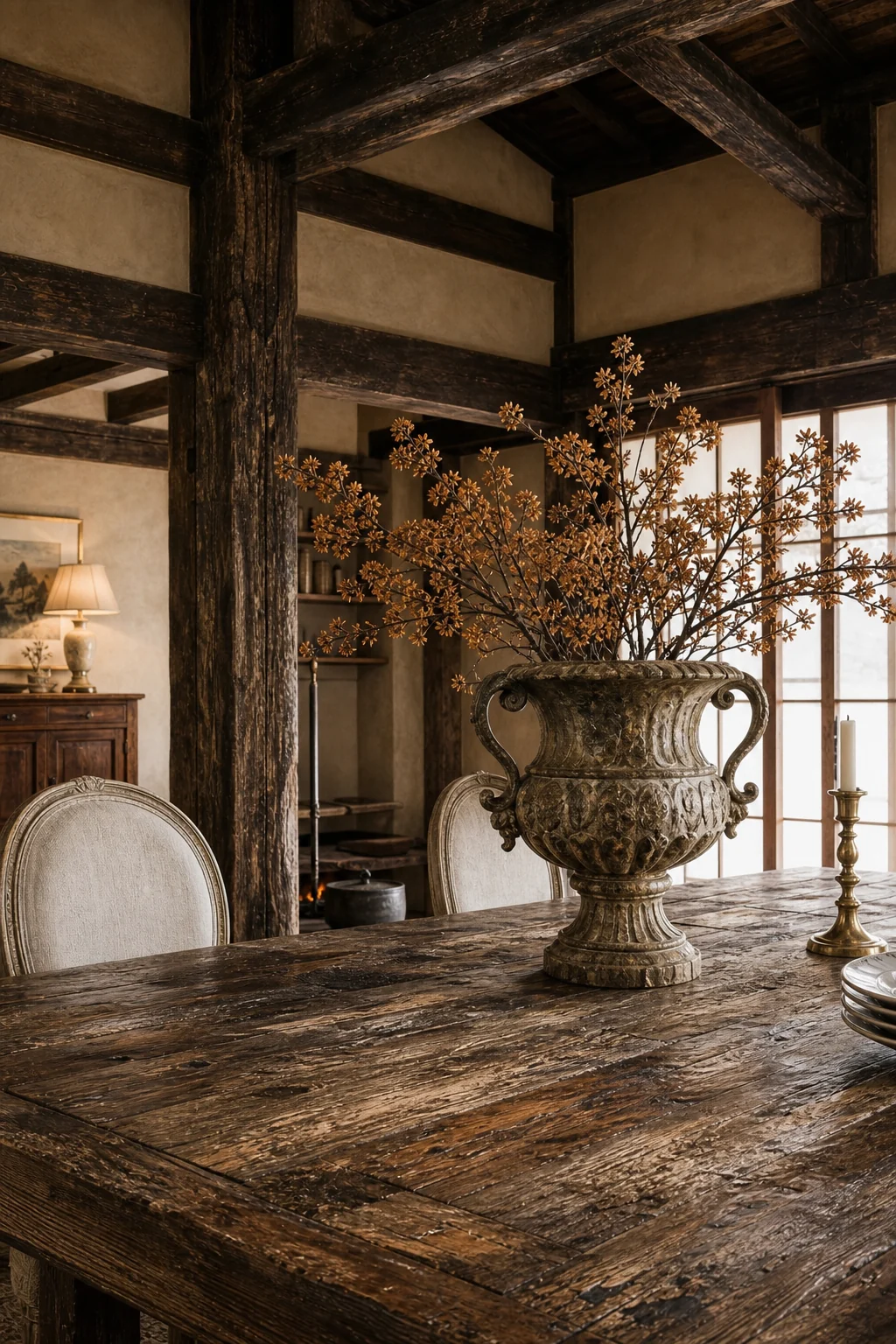
This shared material language allows the eye to travel seamlessly from the rustic ceiling down to the formal dining surface. It unifies the disparate styles by establishing a continuous, comforting thread of rich, historic wood tones throughout the entire space.
- Match the dining table’s primary undertone precisely to the overhead structural ceiling timbers to ensure vertical cohesion.
- Use faded antique gilt to bridge the visual gap between dark rustic wood and light tailored linen.
- Introduce warm earthen grey-beige tones to soften the high contrast between the two distinct historical styles.
Structuring the Dining Space
Center the formal seating arrangement directly beneath the highest point of the exposed timber roof. This symmetrical placement respects strict European layout rules while simultaneously honoring the central hearth tradition of historic agrarian dwellings, creating a powerful focal point.
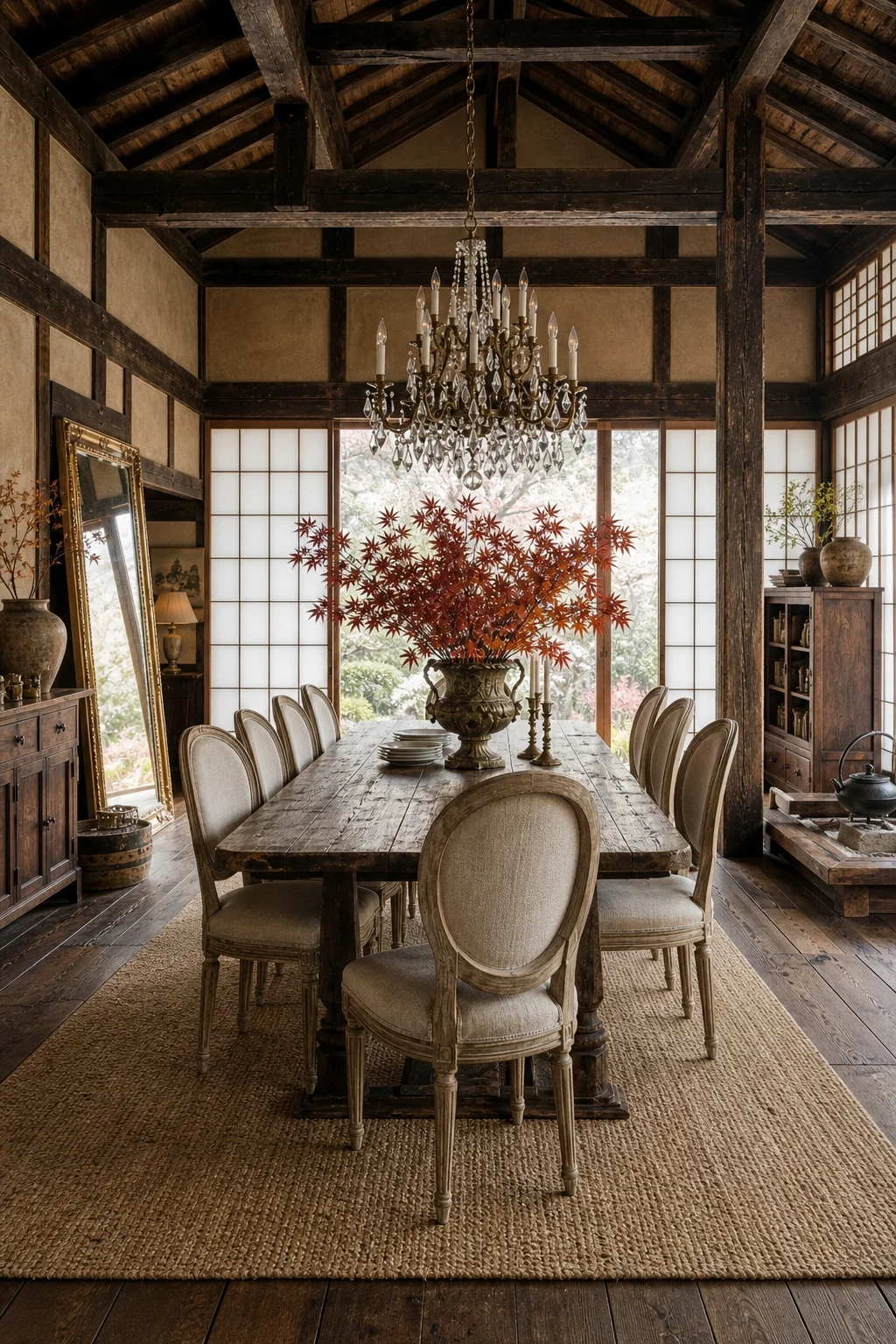
By aligning the European layout with the architectural peak, the room achieves a formal symmetry that feels entirely natural. The structured seating arrangement sits harmoniously within the rustic agrarian shell, creating a highly disciplined yet incredibly inviting dining environment.
| Design Layer | French Traditional Role | Minka Role | Bridge Decision |
|---|---|---|---|
| Architectural Shell | Dictates the formal spatial layout and rigid visual symmetry | Provides heavy dark timber framing and tactile earthen textures | Utilize dark wood framing to clearly outline the space |
| Large Furniture | Introduces delicate fluted profiles and carved wooden chair legs | Supplies massive structural pillars and heavy overhead support beams | Select distressed oak finishes to unite both distinct scales |
| Soft Textiles | Features tailored, tightly upholstered dining chair backs and seats | Utilizes translucent paper screens for soft, ambient light diffusion | Incorporate unbleached natural fibers for all primary seating surfaces |
| Room Lighting | Relies on crystal refraction for sparkling, elegant ambient illumination | Creates a diffused, moody ambient glow across all surfaces | Install tarnished bronze fixtures to successfully anchor the crystals |
| Decor Accents | Employs ornate urns and tall, decorative leaning floor mirrors | Showcases seasonal branch displays and simple, natural organic elements | Adopt muted autumn palettes to blend the ornate ornamentation |
Mapping these specific design roles ensures neither style dominates the other. The heavy timber shell provides the necessary physical boundaries, while the delicate furniture introduces human-scale comfort, resulting in a perfectly balanced, cohesive dining experience that feels both grand and intimate.
Harnessing Natural Light
Crystal chandeliers typically demand grand plaster ceilings to reflect their brilliance. Here, hanging an antique bronze fixture directly from rough-hewn beams allows the delicate crystals to catch the soft, diffused daylight filtering dynamically through the room from the adjacent windows.
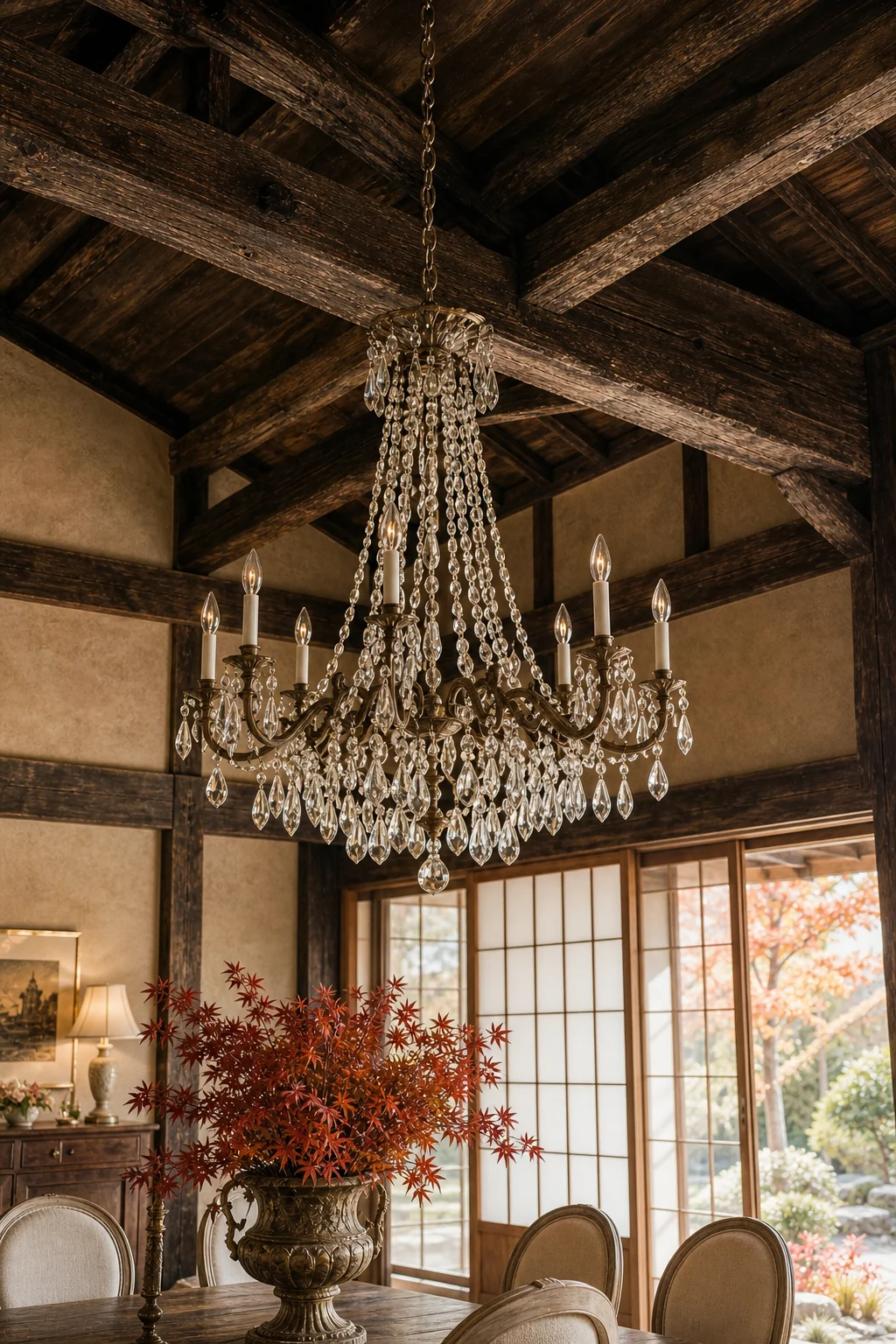
The precise placement of the fixture ensures the crystals actively refract the golden autumn daylight pouring through traditional shoji screens. This interaction creates a perfect, mesmerizing balance of delicate European sparkle and heavy rustic shadow, enhancing the room’s atmospheric depth.
Mastering this natural illumination prevents the chandelier from feeling like an artificial intrusion. When the crystals respond dynamically to the shifting daylight, the ornate European lighting fixture becomes an integrated, living component of the agrarian architecture rather than a mere accessory.
Curating the Accents
Styling this hybrid space requires immense restraint to prevent overwhelming visual clutter. A single ornate urn holding fiery autumn maple branches provides more than enough seasonal drama without disrupting the carefully balanced, muted material palette that defines the entire room.
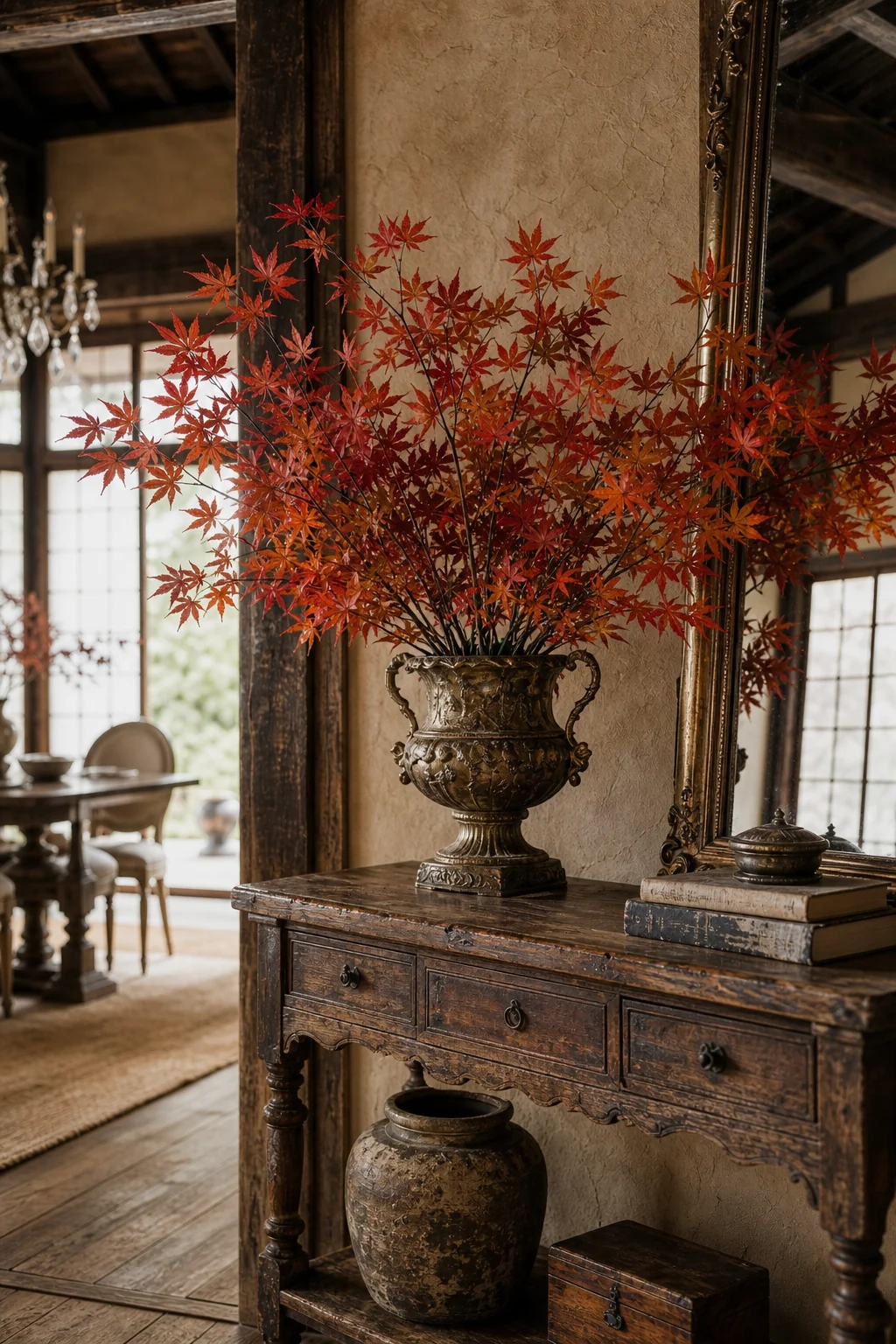
This careful curation elevates seasonal Minka foliage by utilizing European formal styling techniques. It proves that a few well-chosen, highly textured pieces speak much louder than a room crowded with unnecessary decorative accessories that dilute the core design concept.
- Source tarnished bronze and crystal chandeliers to anchor the overhead lighting design effectively.
- Look for heavily distressed oak dining tables that mimic the historic structural beams.
- Find unbleached linen medallion chairs to provide comfortable, neutral formal seating options.
- Invest in large antique gilt mirrors to reflect light and visually expand the space.
Adapting the Threshold
You can easily translate this complex stylistic tension into smaller, transitional spaces. Frame a single carved mahogany side chair and a sparkling wall sconce directly within the heavy, dark timber of a traditional sliding doorway to create a captivating vignette.
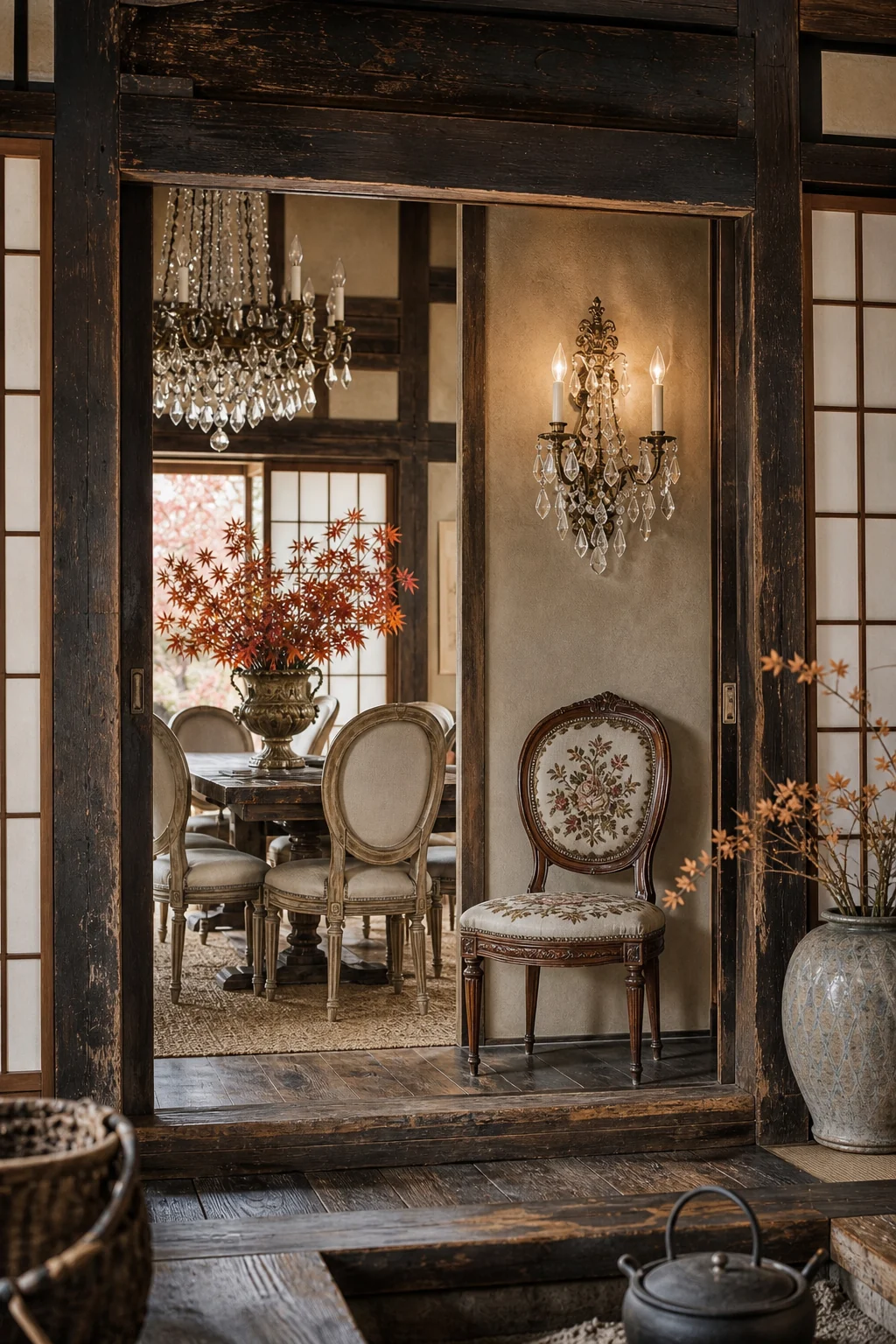
The rustic wooden threshold perfectly frames the delicate vignette, drawing the eye toward the intricate craftsmanship. This technique proves that even a narrow passageway can successfully capture the essence of this complex stylistic hybrid, offering a preview of the main room.
Applying these principles to hallways or entryways establishes a cohesive narrative before guests even reach the main dining area. It sets an immediate expectation of refined contrast, preparing the eye for the dramatic interplay of heavy timber and delicate upholstery ahead.
Avoiding the Costume
A successful hybrid interior never looks like a temporary movie set. When delicate upholstery and crystal lighting share a space with earthen walls, the final result must feel like a naturally evolved, historically grounded home that respects both distinct traditions.
Balanced architecture actively prevents the furniture from feeling overly thematic or contrived. By deeply respecting the structural integrity of both influences, the dining room becomes a believable, aspirational environment that completely transcends simple aesthetic mixing to achieve true design harmony.
- Avoid overloading the room with gilt, which quickly turns the grounded space into a palace.
- Never keep styles strictly on opposite walls; you must blend them thoroughly together everywhere.
- Skip fake foam beams to preserve the required architectural authenticity of the structural ceiling.
- Do not bleach the wood, as this ruins the moody, historic agrarian atmosphere entirely.